 how-to
Emergency PMU Removal: Is It Effective?
Table of Contents
- What Emergency PMU Removal Is and Why Timing Matters
- Emergency Saline Removal for Microblading: How the Procedure Works
- Is Emergency PMU Removal Effective? What the Evidence Says
- Saline Tattoo Removal Effectiveness Compared to Laser
- Fresh Microblading Removal: What Can Be Treated and When
- PMU Removal Aftercare and Healing Timeline
- Risks, Contraindications, and When to Seek Medical Care
- Frequently Asked Questions
Last Updated: October 21, 2026
What Emergency PMU Removal Is and Why Timing Matters
Emergency PMU removal is a corrective treatment performed shortly after permanent makeup application to lift fresh pigment before it settles into the skin.
Permanent makeup, often shortened to PMU, includes microblading, microshading, powder brows, and lip blushing.
That urgency is understandable. It is also where most people make their first mistake: they panic and book the first appointment they find.
The First 24 to 48 Hours: Your Decision Window
The first 24 to 48 hours after a PMU appointment is the decision window for emergency treatment. Fresh pigment sits closer to the surface during this period, which is why saline removal is typically performed within it.
Here is how we would think through the first two days:
- Hours 0 to 24: Contact a qualified technician and describe what you dislike. Expect some redness and darkness; freshly tattooed skin often looks bolder than the final result.
- Hours 24 to 48: If a technician confirms a correction is warranted, treatment is usually scheduled inside this window.
- After 48 hours: Emergency removal is generally no longer an option. Standard removal, which takes multiple sessions, becomes the path.
Emergency Saline Removal for Microblading: How the Procedure Works
Emergency saline removal for microblading is a non-laser technique that applies a saline solution over the fresh pigment to draw it toward the surface. A qualified technician works gently, and the goal is partial lightening, not erasing the brow.
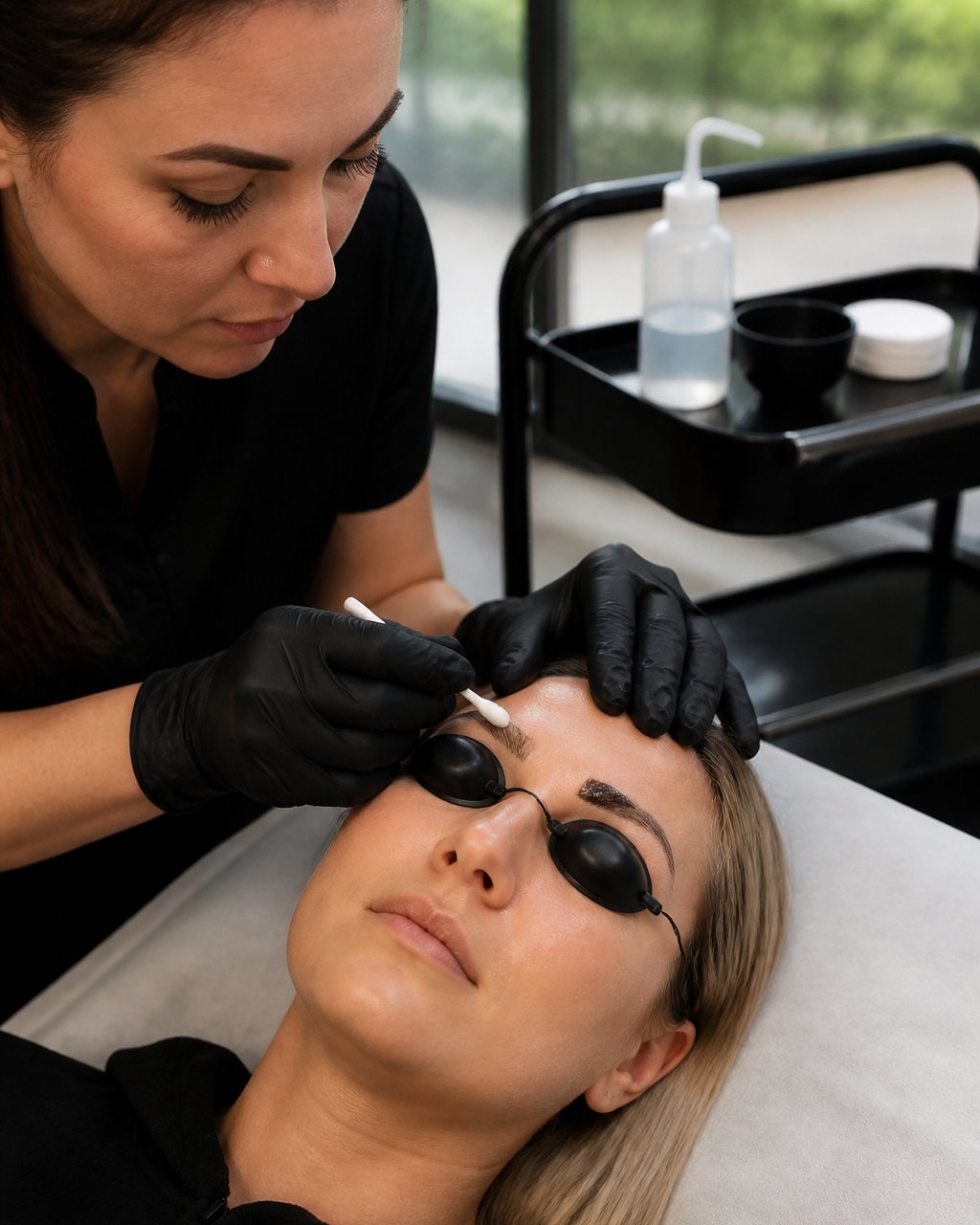
The procedure follows a predictable sequence:
- Consultation and assessment. The technician reviews the brow shape, pigment color, and skin condition.
- Cleaning and preparation. The treatment area is cleaned and prepped.
- Saline application. Solution is worked into the fresh pigment using a gentle technique.
- Pigment extraction. Lifted pigment is wiped away as it surfaces.
- Aftercare instructions. You leave with clear healing guidance.
The appointment is short, and most clients describe it as less intense than the original microblading session. What most guides miss: the technician's judgment matters more than the solution itself.
Is Emergency PMU Removal Effective? What the Evidence Says
Emergency PMU removal can be effective at lightening fresh pigment, but results vary and no method guarantees complete removal. Published evidence on saline removal is limited, and much of what circulates online comes from practitioner experience rather than controlled studies, so "effective" needs a clear definition.
What "Effective" Actually Means: Three Distinct Outcomes
Most guides blur lightening, partial removal, and complete removal into a single promise. They are different outcomes:
- Pigment lightening: The treated area fades enough that a technician can correct shape, color, or density in a later session. This is the most common and most realistic outcome of a single emergency session. It is also the outcome emergency removal is designed for.
- Partial removal: A meaningful portion of pigment lifts, but visible residue remains. Reaching this point usually requires the emergency session plus one or two standard removal sessions spaced weeks apart.
- Complete removal: All visible pigment clears. This is uncommon from emergency treatment alone and typically requires multiple standard sessions over months, sometimes with a different method such as laser once the skin has healed.
A useful way to think about it: emergency removal is a correction tool, not an undo button. Its job is to create a better starting point for a proper correction later, not to erase the brow in one appointment.
The Evidence Gap: What We Know and What We Don't
The clinical evidence for saline removal during the emergency window is thin. There are no large controlled trials comparing saline outcomes against laser or natural fading, and success rates quoted online often come from practitioner experience rather than published research, unverified, not necessarily false. A balanced way to read the evidence:
- What is well established: Fresh pigment sits closer to the skin surface and is more responsive to removal than settled pigment. This is a mechanical reality, not a marketing claim.
- What is plausible but not proven: That a single emergency saline session reliably lightens pigment by a specific amount. Most practitioners report lightening, but the degree varies widely by client.
- What is not established: Comparative success rates between saline and laser in the emergency window, or a guaranteed number of sessions to reach a given outcome.
When a provider promises a specific result, ask what that promise is based on. A cautious technician will describe a range of possible outcomes, not a fixed one.
Four Factors That Drive Your Result
Effectiveness is not a single number. It depends on interacting factors:
- Pigment color: Darker, cooler pigments (blacks, cool browns) tend to behave differently than warm or light pigments. Some pigment particles are more mobile in the skin than others, and color can shift as pigment breaks down.
- Pigment depth: Shallow placement lifts more readily than deep placement. Microblading strokes placed near the surface are generally more responsive than densely shaded powder-brow work.
- Skin type: Oily or sensitive skin can heal unpredictably, and sebum production can affect how pigment settles and how the treated area recovers.
A qualified technician will assess these factors during consultation and give you a realistic range, not a guarantee.
Lightening vs. Complete Removal: Setting Realistic Expectations
Lightening and complete removal are different outcomes, and confusing them leads to disappointment. Emergency treatment softens unwanted pigment so a technician can correct the brow shape later; complete removal usually requires a series of standard sessions over weeks.
| Outcome | What It Means | Typical Path |
|---|---|---|
| Partial lightening | Pigment fades enough to correct the shape | One emergency session, then a correction appointment |
| Significant lightening | Most pigment lifts, some remains | Emergency session plus one or two standard sessions |
| Complete removal | All pigment clears | Multiple standard sessions over months |
The American Academy of Micropigmentation sets professional standards for PMU practitioners, and its guidance reflects what experienced technicians already know: correction work is a judgment call, not a formula.
Saline Tattoo Removal Effectiveness Compared to Laser
Saline tattoo removal and laser removal work on completely different principles, and the right choice depends on timing.
Here is the practical difference:
- Saline is the option for fresh pigment inside the 48-hour window. It is gentle and does not require a physician.
- Laser is generally used on settled pigment after the skin has healed. It is performed in a medical or clinical setting.
- Combination approaches exist, but a qualified technician should advise on sequencing.
The U.S. Food and Drug Administration guidance on tattoo removal notes that removal methods carry risks and that results vary by pigment and skin.
Our view: saline versus laser is not a contest. It is a timing question. Fresh pigment calls for saline; settled pigment calls for a clinical assessment.
Fresh Microblading Removal: What Can Be Treated and When
Fresh microblading removal works best on brows treated within the first two days. Microblading deposits pigment in fine strokes near the surface, which makes early removal more forgiving than deeply shaded techniques.
Which treatments may be considered:
- Microblading and microshading: Often treatable in the emergency window.
- Powder brows: Denser pigment can lift, though results vary.
- Lip blushing: More delicate; a technician should assess carefully.
The brow shape, pigment color, and pigment depth all affect what is possible. A qualified technician will tell you honestly when emergency treatment is not the right call.
Emergency removal is a correction tool, not an undo button. Its job is to create a better starting point for a proper correction later.
PMU Removal Aftercare and Healing Timeline
PMU removal aftercare decides much of the outcome. The skin has just been through two procedures in quick succession, so it needs calm and consistency. Picking, scrubbing, or letting the area dry out can pull pigment unevenly and leave a patchy result that is harder to correct later.
A Specific Aftercare Protocol
Follow these steps unless your technician gives you different instructions:
- First 24 hours: Keep the area clean and dry. Gently pat, do not rub, with a clean, soft cloth if needed. Avoid makeup, skincare products, and direct sun on the treated area.
- Days 2 to 7: Wash gently with a mild, fragrance-free cleanser and lukewarm water, then pat dry. Apply any aftercare product your technician recommends sparingly, a thin layer is enough. Do not soak the area.
- Avoid throughout early healing: Saunas, hot tubs, swimming pools, heavy sweating, direct sun, and exfoliating products. These increase irritation and can affect pigment retention.
What Healing Actually Looks Like: A Realistic Timeline
Healing is not linear, and the brow will often look worse before it looks better. A realistic timeline:
- Days 1 to 3: Redness, tenderness, and darker pigment. The treated area may look bolder than before treatment, this is normal and expected.
- Days 4 to 10: Light scabbing and flaking begin. The area may itch. Do not pick. Pigment may appear to lift with the flakes, which is part of the process.
- Weeks 2 to 4: Color settles and lightening becomes visible. The skin may still be slightly pink or sensitive.
Warning Signs: When to Seek Medical Care
Most reactions are mild and resolve on their own. Seek medical care promptly if you notice:
- Spreading redness, warmth, or swelling beyond the treated area
- Pus or unusual discharge
- Fever or chills
- Pain that worsens after the first couple of days rather than improving
Those are signs of infection or an allergic reaction, not normal healing. The Centers for Disease Control and Prevention publishes guidance on skin infection warning signs worth knowing.
takeaway Aftercare is not passive. Keeping the area clean, dry, and protected, and leaving scabs alone, gives the skin the best chance to heal evenly and preserves the correction you paid for.
Risks, Contraindications, and When to Seek Medical Care
Emergency PMU removal carries real risks, and anyone who tells you otherwise is selling something.
Skip emergency removal, or get medical clearance first, if you:
- Are pregnant or breastfeeding
- Have an active skin infection or open wound near the area
- Have a history of keloid scarring
- Are taking blood thinners or have a bleeding disorder
Seek medical care promptly if you notice spreading redness, pus, fever, or pain that worsens after the first couple of days.
At Tonni Petty PMU Artistry, our 22 years in permanent cosmetics have taught us one lesson above all: a cautious technician who says "let's wait" is worth more than a fast appointment.
If you are staring at brows you regret, the clock is running. Emergency PMU removal is time-sensitive, and the right practitioner makes all the difference.
Frequently Asked Questions
How soon after permanent makeup can emergency removal be done?
Emergency PMU removal is typically performed within the first 24 to 48 hours after the initial procedure, while the pigment is still fresh and sitting in the upper layers of the skin. The sooner you act, the better the chances of lifting a meaningful amount of pigment. After 48 hours, the skin begins to heal and pigment settles deeper, making removal more difficult and often requiring multiple sessions.
Does emergency saline removal work for fresh microblading?
Yes, emergency saline removal can be effective for fresh microblading, especially when done within the first 48 hours. The saline solution helps draw pigment out of the skin before it fully settles. Results vary based on pigment depth, color, and how quickly treatment is started. Many clients see significant lightening, though complete removal is not guaranteed and a follow-up session may be needed.
What should I do if I am unhappy with fresh permanent makeup?
Contact a qualified PMU removal technician immediately. Do not try to remove pigment at home or pick at the area. Avoid sun exposure and harsh skincare. A professional can assess whether emergency saline removal is appropriate within the 48-hour window. If that window has passed, discuss options such as saline or laser removal sessions and follow aftercare instructions carefully to support healing.
Can emergency PMU removal completely erase the pigment?
Complete removal in a single emergency session is uncommon. Most clients achieve partial to significant lightening, which may be enough to correct the shape or color. For full removal, multiple sessions spaced weeks apart are often required. Pigment color, depth, skin type, and treatment area all affect outcomes. A consultation with a master technician can give you a realistic expectation.