 how-to
How to Find a Medical Tattoo Specialist Near You
Table of Contents
- Start Your Search for a Medical Tattoo Specialist Near You
- What a Medical Tattoo Specialist Actually Does
- Medical Tattoo Artist Credentials: What to Verify Before You Book
- How to Judge a Portfolio of Healed Results
- Medical Tattoo Consultation Questions to Ask
- Medical Tattoo Cost and Insurance Coverage
- Medical Tattoo Healing Time and Candidacy
- Frequently Asked Questions
Last Updated: October 20, 2026
Start Your Search for a Medical Tattoo Specialist Near You
Finding a medical tattoo specialist near you starts with knowing what to search for and what to verify.
Here's the problem: a standard search returns a mix of cosmetic studios, salon chains, and general permanent makeup artists.
So you need a filter. Start with these search terms:
- "paramedical tattoo artist" plus your city
- "areola tattoo specialist" or "nipple tattoo artist"
- "scar camouflage specialist near me"
Then check each result against three things: stated specialty, proof of healed work, and licensing.
Below, we'll walk through the full vetting process, from credentials to consultation questions to cost and healing.
What a Medical Tattoo Specialist Actually Does
A medical tattoo specialist is a trained artist who uses pigment to restore skin appearance after medical treatment, surgery, or hair loss. The work is sometimes called paramedical tattooing or restorative tattooing.
The distinction matters when you're searching. A brow artist who also offers areola work is not the same as an artist who specializes in it. Restorative work demands different color matching, different technique, and a different understanding of scar tissue.
3D Areola and Nipple Restoration
This is the most requested form of medical tattooing. After mastectomy or breast reconstruction, 3D areola tattooing recreates the look of a nipple and areola using layered pigment. The artist builds shadow and highlight so the result reads as three-dimensional from a normal viewing distance.
Good artists match pigment to your skin tone, not a standard chart. They also account for how scar tissue holds color differently than intact skin.
Scar Camouflage and Post-Surgical Work
Scar camouflage blends pigment into pale or discolored scar tissue so it matches surrounding skin. Common targets include surgical scars, stretch marks, and graft sites. Scar revision with pigment is a related service, though it works on color rather than texture.
Top surgery and gender-affirming care also fall under this umbrella. Artists who serve these clients understand chest contouring and nipple reconstruction after masculinizing procedures.
Medical Tattoo Artist Credentials: What to Verify Before You Book
Credentials separate serious specialists from hobbyists. Verify these before you book a consultation:
- Licensing: Your state health department should list the artist or studio. Ask for the license number and confirm it.
- Insurance: A legitimate studio carries liability insurance. Ask directly.
- Specialized training: General permanent makeup certification is a start. Restorative-specific training is better.
A common mistake is assuming a salon license covers tattoo work. It often doesn't. Check the specific license category.
How to Judge a Portfolio of Healed Results
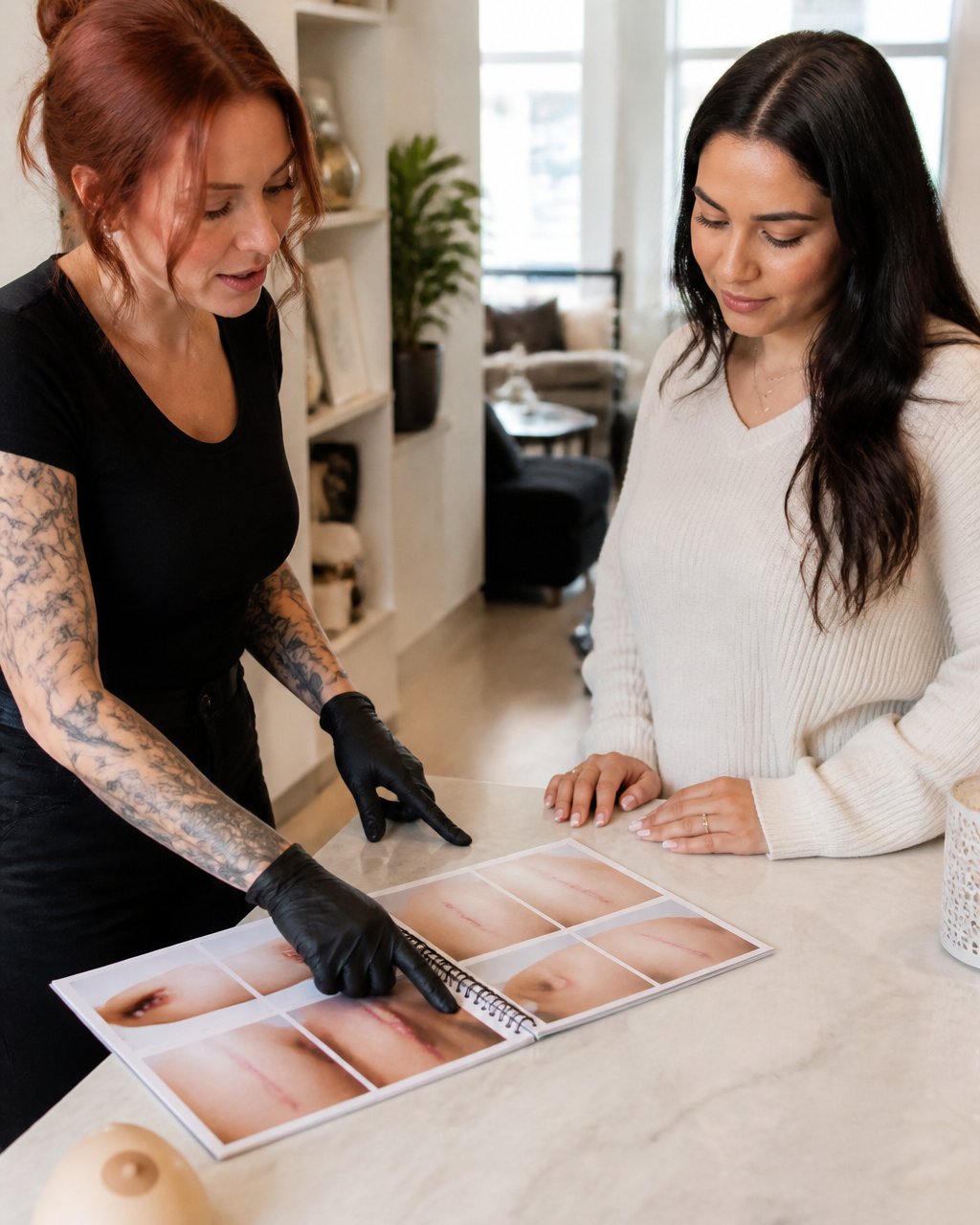
Healed photos are the only portfolio that counts. Fresh tattoos look sharp and saturated. Healed results show what pigment actually does in skin over weeks and months.
Ask for healed before-and-after photos specifically. Then look for these signals:
- Color stability: Pigment should stay true, not shift orange or gray.
- Natural-looking results: Areola work should show soft edges and realistic shading, not a flat circle.
- Consistency: Multiple healed examples, not one lucky case.
Medical Tattoo Consultation Questions to Ask
A consultation is where you separate a specialist from a generalist, but the questions only work if you have already narrowed the field. Most people skip that step and walk into the first studio that returns their call. Here is the full process, from search to signed consent.
Step 1: Run a location-aware search
Generic searches return a mix of cosmetic studios, salon chains, and general permanent makeup artists. Filter the results before you contact anyone:
- Search "paramedical tattoo artist" plus your city and the surrounding metro, then repeat with "areola tattoo specialist," "nipple tattoo artist," and "scar camouflage specialist near me."
- Add "scalp micropigmentation" if hair restoration is your goal.
- Cross-check each name against a professional directory such as the American Academy of Micropigmentation or the American Institute of Intradermal Cosmetics, which list artists by specialty and region.
Step 2: Filter by service fit before you call
Open each candidate's site and look for three things: a stated restorative specialty, healed before-and-after photos, and a service list that is not twenty items long. An artist who lists medical tattooing as one line among brow, lip, and eyeliner services is a generalist. Skip them unless their healed portfolio proves otherwise.
Step 3: Compare nearby specialists on the same criteria
Build a simple comparison before you book consultations. For each of your top three candidates, note:
- Years doing restorative work specifically, not total years in permanent makeup.
- Whether they show healed results for your surgery type and skin tone.
- Licensing and liability insurance status.
This side-by-side is what turns a list of names into a decision.
Step 4: Ask the questions that reveal real experience
Come to the consultation with specific questions and listen for specific answers:
- How many procedures like mine have you completed, and can I see healed photos from clients with my skin tone and surgery type?
- What pigment line do you use, and how has it held up in your healed results over time?
- How many sessions will I need, how far apart, and is the refinement session included in the quote?
- What does aftercare look like, and what is your process if healing goes unevenly?
- What are your health and safety protocols for sterile equipment and single-use needles?
- How do you handle color correction if the result is not right?
- What are your limits, when would you decline to tattoo a client, and why?
An artist who answers in exact terms has done the work. One who deflects or answers only in generalities is telling you something.
Step 5: Confirm candidacy and timing
Ask directly whether your scar is mature enough, whether any current medication or treatment affects healing or pigment retention, and whether the artist wants clearance from your care team first. Honesty about limits is a good sign, not a red flag.
Bring a printed list of your questions and take notes during the consultation. Comparing three studios from memory is unreliable, and the details, session counts, inclusion of touch-ups, aftercare specifics, are exactly what you will need to weigh later.
If a studio will not show healed results, will not confirm licensing and insurance, or pressures you to book a date before answering your questions, walk away. The consultation is the test; a specialist expects to pass it.
Medical Tattoo Cost and Insurance Coverage
Medical tattoo pricing is one of the least transparent parts of the search, and most studio pages dodge the question entirely. That leaves you comparing quotes with no frame of reference. Here is a practical way to get real numbers before you commit.
What drives the price
A reputable artist prices by procedure, not by the hour, because restorative work is judged on outcome rather than time at the chair. The factors that move the number most:
- Service type. 3D areola and nipple restoration is typically priced per breast and often bundled as a two-session package. Scar camouflage is usually quoted by the length and complexity of the scar. Scalp micropigmentation is commonly priced per session across a multi-session series.
- Number of sessions. Most restorative work needs an initial session plus at least one refinement session after healing. Ask whether the quote covers the full series or only session one.
- Artist experience and demand. A specialist with a long healed-results portfolio and a waitlist will price above a general permanent makeup artist adding restorative work as a side service.
How to request a written estimate
Do not accept a phone quote as final. Ask for a written estimate that itemizes:
- The procedure name and the number of sessions included.
- Whether the refinement or touch-up session is included or billed separately.
- The cost of a consultation, and whether it is credited toward the procedure if you book.
- Any charges for color correction or additional sessions beyond the quoted series.
- The cancellation and rescheduling policy.
A written estimate protects you and signals that the studio runs on process rather than improvisation. If an artist will not put numbers in writing before you book, treat that as a warning sign.
Verifying insurance coverage
Some health plans treat restorative tattooing following mastectomy as part of breast reconstruction, and a smaller number cover scar camouflage when it is tied to a covered procedure. Most plans, however, classify the work as cosmetic. The only reliable answer comes from your own plan documents and a direct call to your insurer.
Work through it in this order:
- Read your plan's summary of benefits. Look for language on reconstructive services and any explicit exclusion for tattooing or micropigmentation.
- Call member services and ask for the specific billing code. Ask whether the procedure is covered when performed by a licensed tattoo artist versus a medical provider, because many plans only reimburse when the service is billed through a physician's office.
- Ask the artist what documentation they provide. A studio experienced with insurance claims can supply procedure notes, receipts, and sometimes a superbill you can submit for reimbursement.
Ask two questions before you commit: what the full treatment will cost across every session, including the refinement, and whether the artist supplies itemized paperwork you can submit to your insurer. Get both answers in writing. Those two documents prevent almost every cost surprise.
Be cautious of any studio that quotes a single flat price before seeing your skin, or that promises insurance will 'probably' cover the work. Both are guesses dressed up as answers.
Medical Tattoo Healing Time and Candidacy
Medical tattoo healing time runs about two to four weeks for surface healing, with full pigment settling taking longer.
Candidacy depends on a few factors:
- Scar maturity: Most artists wait until scars are fully healed, often several months after surgery.
- Active treatment: If you're mid-chemo or awaiting another procedure, timing matters. Ask your care team first.
- Skin condition: Active infections or flare-ups mean waiting.
Aftercare is simple but strict: keep the area clean, avoid sun, skip harsh products, and follow the artist's instructions exactly.
If you're considering scalp micropigmentation for hair restoration, the same timing rules apply.
Finding the right medical tattoo specialist takes more than a quick search.
Frequently Asked Questions
What is a medical tattoo specialist?
A medical tattoo specialist is a trained permanent makeup or paramedical tattoo artist who restores skin appearance after surgery, injury, or medical treatment. Their work includes scar camouflage and scalp micropigmentation for hair loss. Unlike a purely cosmetic artist, they plan around scar tissue, compromised skin, and medical timing, and they often coordinate with surgeons or oncologists. Ask whether the artist holds certifications such as those from the American Institute of Intradermal Cosmetics and whether they are licensed and insured.
Does insurance cover medical tattooing?
Coverage varies by plan. Some health insurers treat nipple-areola restoration after mastectomy as part of reconstructive care, but you must confirm with your own plan. Request a written cost estimate and a procedure code from the provider, then call your insurer before booking. Cosmetic tattooing and scar camouflage for non-medical reasons is almost never covered. Keep receipts and documentation in case you need to submit a claim.
How much do medical tattoos cost?
Medical tattoo cost depends on the procedure, the size of the area, the number of sessions, and the artist's experience level. Scar camouflage and scalp micropigmentation are priced differently, and most plans include a follow-up session. Rather than quoting a number, ask each provider for a written estimate that lists the initial session, touch-ups, and any consultation fee. Compare those estimates line by line, and ask whether the artist offers payment plans or documentation you can submit to insurance.
How long does medical tattooing take to heal?
Surface healing usually takes one to two weeks, with pigment settling and true color visible at around four to six weeks. Medical tattoo healing time can run longer over scar tissue or skin treated with radiation, so a follow-up session is often scheduled eight to twelve weeks later. Follow aftercare instructions closely: keep the area clean, avoid sun exposure, skip pools and saunas during the first weeks, and do not pick at flaking skin. Ask your artist what healing looks like at each stage so you know what is normal.