 how-to
PMU Correction Over Scar Tissue: What You Need to Know
Table of Contents
- Can You Get PMU Correction Over Scar Tissue?
- Understanding Scar Tissue and How It Differs From Healthy Skin
- Microblading Over Scar Tissue: Suitability and Contraindications
- Permanent Makeup Over Eyebrow Scars: Technique Adjustments
- Microblading Scar Tissue Healing: Timeline and Aftercare
- Medical Screening and When to Seek Referral
- Risks of Repeated Touch-Ups and Additional Scarring
- Alternatives to PMU for Scar Camouflage
- Frequently Asked Questions
Last Updated: October 18, 2026
Can You Get PMU Correction Over Scar Tissue?
Yes, pmu correction scar tissue is possible, but it requires careful assessment and specialized technique. Success depends on the scar's age, texture, and how your skin heals.
Mature scars that are flat and stable respond well to PMU correction.
Understanding Scar Tissue and How It Differs From Healthy Skin
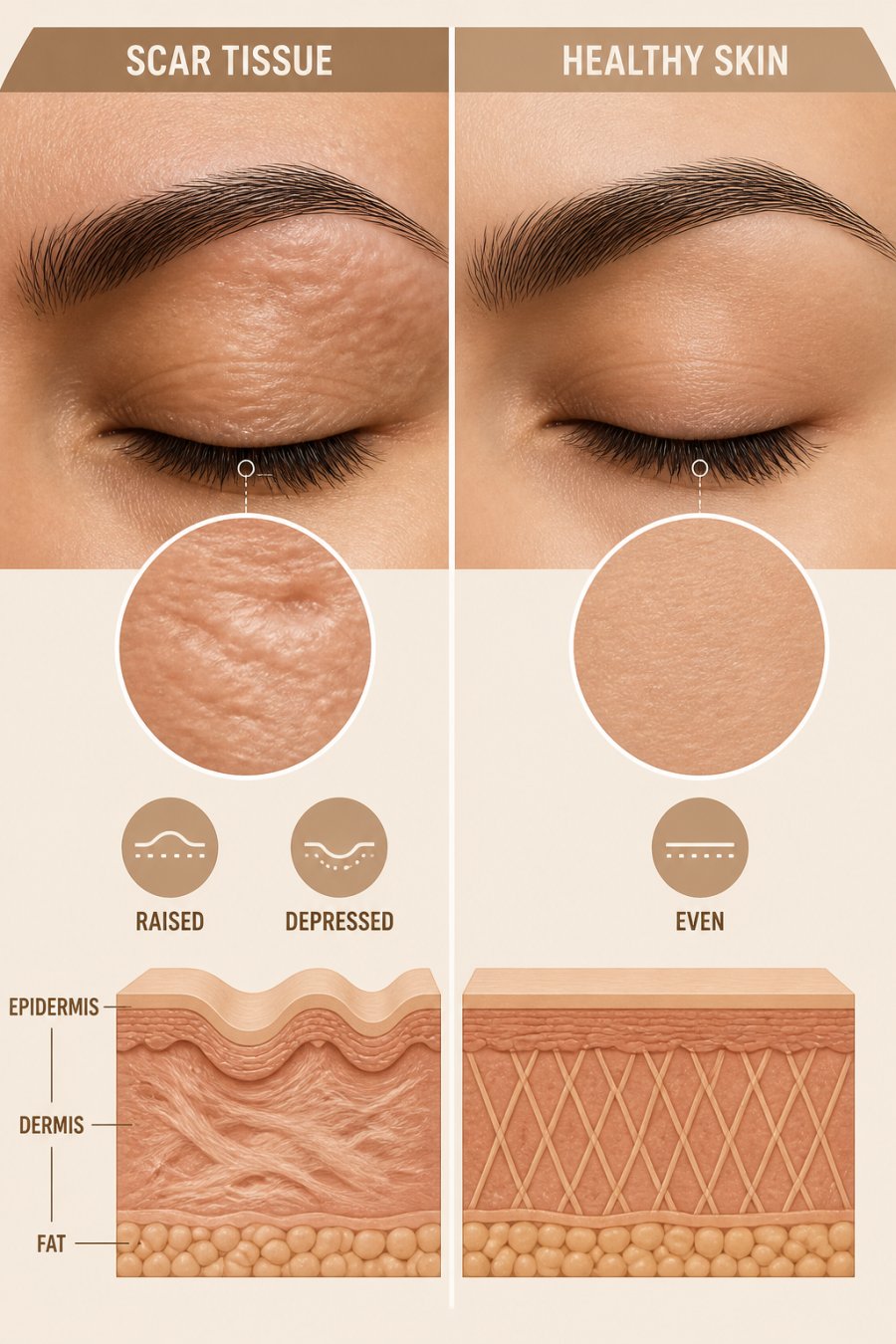
Scar tissue lacks normal skin structure, oil glands, and hair follicles, so pigment behaves differently on scars. Altered collagen and reduced elasticity mean pigment may not hold evenly and color can shift during healing. Scarred eyebrows also respond unpredictably to numbing agents because of altered nerve endings, some clients feel more pain, others less. Healing takes longer: inflammation lingers, scabs form differently, and pigment can migrate or fade unevenly.
Scar Age, Thickness, and Activity
Scar age matters most. Fresh scars (under 12 months old) are still remodeling, so PMU risks additional trauma and unpredictable results.
Thickness and texture determine how pigment will sit. Raised scars create an uneven surface, depressed scars create valleys where pigment pools, and flat, thin scars accept pigment most predictably.
Scar activity refers to how actively your body is still healing it.
Types of Eyebrow Scars and Their Causes
Trauma scars from cuts, accidents, or injuries vary widely in depth and texture and are often irregular.
Surgical scars tend to be cleaner and more predictable than trauma scars, making them better PMU candidates.
Atrophic scars are depressed and sunken, common from acne or chickenpox; pigment settles unevenly in the depression, making them challenging.
Hypertrophic scars are raised and thick, common after burns or aggressive healing; the uneven surface makes them difficult to work over.
Microblading Over Scar Tissue: Suitability and Contraindications
Microblading over scar tissue is possible but limited: its hair-like strokes may not hold pigment consistently on scarred skin.
Suitable scars for microblading:
- Flat, mature scars (18+ months old)
- Thin scars without raised or depressed texture
- Scars that are pale or white (inactive)
Contraindications (when NOT to microblad over scars):
- Fresh scars under 12 months old
- Keloids or hypertrophic scars
- Highly textured or deeply depressed scars
If your scar doesn't fit the suitable category, powder brows or combo brows might work better, their different needle depths and saturation levels adapt to compromised skin.
Permanent Makeup Over Eyebrow Scars: Technique Adjustments
Professional PMU artists modify their approach for pmu correction scar tissue to maximize pigment retention and minimize additional trauma.
Needle Pressure and Pigment Saturation on Compromised Skin
Needle pressure on scar tissue must be lighter than on healthy skin; scars have less elasticity, and aggressive pressure can cause more scarring or pigment migration.
Pigment saturation, how much color gets pushed into the skin, needs adjustment on scarred skin; heavy saturation on thin scars can cause uneven settling or blurring. Most professionals use medium saturation on mature scars, balancing pigment visibility with unpredictable scar tissue healing.
Pigment Retention and Uneven Healing on Scarred Skin
Pigment retention on scarred eyebrows is less predictable than on healthy skin, some areas hold well, others fade faster, and this unevenness is expected.
Uneven healing is the biggest challenge: scar tissue and surrounding healthy skin heal at different rates, so pigment can appear darker in some areas and lighter in others. Your artist should discuss this risk beforehand; some unevenness is normal and often improves with touch-ups.
Microblading Scar Tissue Healing: Timeline and Aftercare
Week 1: Swelling and redness peak. Scabs form. The brows look darker than the final result.
Weeks 2-3: Scabs flake off. The color appears lighter. This fading is temporary.
Weeks 4-6: Color stabilizes. The final shade emerges.
Months 2-3: Final results appear. If color is uneven or faded, this is when touch-ups are scheduled.
Aftercare for scarred skin:
- Keep the area clean and dry for 7-10 days
- Use recommended ointment sparingly (over-moisturizing slows healing)
- Avoid water, sweat, and sun exposure during the first week
Scar tissue is more prone to complications.
Medical Screening and When to Seek Referral
A thorough medical screening is the difference between a predictable result and a complication. Your artist should ask detailed questions about your scar history, healing patterns, and medical conditions, and should be willing to refer you to a physician when anything is unclear.
What a Good Screening Covers
Questions your artist should ask:
- When did the scar form, and how? (trauma, surgery, burn, acne, infection)
- Has the scar changed in size, color, shape, or sensation recently?
- Do you have a personal or family history of keloids or hypertrophic scarring?
Red Flags That Require Medical Evaluation First
Defer PMU and see a physician if any of the following apply:
- The scar is still changing, growing, darkening, or changing shape.
- The scar is painful, itchy, hot, or inflamed without an obvious cause.
- The scar is ulcerated, bleeding, or draining.
Timing: When Is a Scar Ready for Assessment?
A common clinical rule of thumb is that a scar should be fully mature before needling, often described as at least 12 months after the injury, and many practitioners prefer 18 months or longer for facial scars.
If you are unsure, the safest path is a dermatologist evaluation. Ask specifically whether the scar is mature, whether there is any keloid tendency, and whether there is any reason to avoid needling.
What a Dermatologist Evaluation Can Cover
A dermatologist can:
- Confirm the scar type (flat, raised, depressed, keloid) and maturity.
- Rule out any lesion that needs biopsy or treatment.
- Advise on scar treatment (laser, silicone, filler, or revision) that could improve the surface before PMU.
How to Communicate With Your Artist
Bring a short written history to your consultation: when and how the scar formed, any treatments to date, medications, and any prior clearance from a physician. Ask your artist directly: Have you worked on this scar type before? What is your plan if pigment heals unevenly? Will you stop and refer me if you see something concerning? A cautious artist will welcome these questions.
Risks of Repeated Touch-Ups and Additional Scarring
Touch-ups are normal for PMU, but repeated procedures over scar tissue carry cumulative risks. Each touch-up needles the same area again, creating additional micro-trauma. On healthy skin this is manageable; on scar tissue, repeated trauma can trigger more scarring.
Risks of repeated touch-ups on scarred skin:
- Additional scar formation from repeated needling
- Pigment migration or blurring from cumulative trauma
- Texture changes in the scar tissue
Most artists recommend spacing touch-ups 12-18 months apart on scarred skin, compared to 12-24 months on healthy skin, giving tissue time to fully recover between procedures.
Alternatives to PMU for Scar Camouflage
If your scar isn't a good candidate for PMU correction, or you want to compare options before committing, several alternatives exist. The right choice depends on your scar type, whether it is active or mature, and whether your goal is coverage, texture improvement, or a trial run.
Decision Guide by Scar Type and Goal
| Your situation | Best first step | Why |
|---|---|---|
| Fresh scar (under 12 months), still red or pink | Wait; use camouflage makeup in the meantime | Active scars are still remodeling and should not be needled |
| Mature, flat, pale scar; you want brow definition | PMU correction (powder or combo brows) is reasonable | Flat, inactive scars accept pigment most predictably |
| Raised (hypertrophic) scar | Dermatologist evaluation first; consider scar treatment before PMU | Raised texture creates an uneven surface and needling risk |
| Keloid-prone or history of keloids | Avoid tattooing over the scar; consult a dermatologist | Trauma can trigger further keloid growth |
| Depressed (atrophic) scar | Consider filler or laser to level texture, then reassess PMU | Pigment pools in depressions and heals unevenly |
| Old, unwanted PMU plus a scar | Removal or lightening first, then corrective PMU | A cleaner canvas improves predictability |
| Unsure or want a reversible trial | Brow pencil, powder, or tinted gel | Non-permanent, adjustable, works on any scar type |
Non-Permanent Coverage: Makeup and Tinting
Brow pencils, powders, pomades, and tinted gels offer adjustable, reversible coverage on any scar type. They are the safest way to trial a shape and color before any permanent procedure, and the only realistic option while a scar is still active. Professional camouflage makeup (corrective or paramedical makeup) offers higher coverage and can be color-matched to surrounding skin.
Scar Treatment Before or Instead of PMU
Improving the scar itself can make future PMU more successful, or remove the need for it.
- Laser therapy: Fractional laser treatments stimulate collagen remodeling and can soften texture and improve color. A dermatologist can assess whether your scar type responds. Timing matters: many practitioners prefer to let laser-treated skin fully heal before needling.
- Dermal fillers: Temporary fillers can raise depressed (atrophic) scars to create a more level surface for pigment. Results are temporary and require maintenance, so this is usually a staged approach rather than a one-time fix.
- Scar revision surgery: A dermatologist or plastic surgeon can assess whether surgical revision would improve texture or appearance. This is typically reserved for scars that are functionally or cosmetically significant.
Correcting or Removing Existing PMU First
If you already have old or unwanted PMU in or around the scar, removal or lightening can give a cleaner canvas. Options include laser removal (performed by a qualified provider) and specialized lightening techniques offered by some PMU artists. Removal is not risk-free on scarred skin, it can affect texture and pigment, so decide with both a removal provider and your PMU artist.
Other PMU Techniques That May Fit Better
If microblading isn't ideal for your scar, other permanent makeup styles use different needle depths and saturation patterns:
- Powder brows: A stippling technique that builds soft shading; often more forgiving on textured or uneven skin than crisp hair strokes.
- Combo brows: Blends microblading strokes with powder shading for more coverage and pigment retention.
- Scar camouflage PMU: A specialized approach that aims to blend scar color toward surrounding skin rather than create brow hair; suitability depends on scar size, location, and tone.
The best option depends on your scar type, skin tone, and goals. A consultation with an experienced PMU artist, ideally one who will refer you out when appropriate, can help you weigh these alternatives honestly.
Frequently Asked Questions
How long should a scar heal before getting permanent makeup?
Most scars require 12 to 18 months of maturation before PMU correction is considered. Newer scars are still active and remodeling; applying pigment too early risks uneven healing and poor retention. Mature scars have stabilized in texture and color, making them more predictable candidates. Your PMU artist should assess scar age during consultation to determine readiness and adjust technique accordingly.
Why does pigment heal unevenly over scar tissue?
Scar tissue has reduced blood flow and altered cellular structure compared to healthy skin, affecting how pigment integrates and heals. Areas of dense scar tissue may accept pigment differently than surrounding skin, leading to patchy color, fading, or unexpected color shifts. The compromised skin cannot hold pigment with the same consistency as unaffected areas, making touch-ups and color correction common with PMU over scars.
Can microblading work on eyebrow scars, or should I choose a different technique?
Microblading over scar tissue is possible but carries higher risk of poor retention and uneven results. Powder brows or combo brows may be better suited to scarred eyebrow areas because they deposit pigment differently and can provide more even coverage on compromised skin. Your PMU artist will assess your specific scar type, thickness, and maturity to recommend the most suitable technique during your consultation.
What are the main risks of getting PMU correction over scars?
Key risks include uneven pigment retention, color shifting or fading faster than expected, additional scarring from needle trauma, and the need for frequent touch-ups. Keloid or hypertrophic scars carry higher risk of worsening. Some scars may not accept pigment well enough to justify the procedure. A thorough medical screening and honest discussion with your PMU artist about your scar history and expectations is essential before proceeding.