 ultimate-guide
Permanent Makeup Certification for Licensed Estheticians
Last Updated: October 23, 2026
Quick Summary
Permanent makeup certification is the formal credential confirming you completed approved cosmetic tattooing training and can legally perform procedures under state rules. As a licensed esthetician, you already hold the skin anatomy, sanitation, and consultation foundation, so most programs require only your esthetician license, a bloodborne pathogens certificate, and a minimum age of 18 before enrollment.
- Your esthetician license does not automatically authorize tattooing; cosmetic tattooing is usually regulated separately.
- State health departments, not cosmetology boards, usually regulate cosmetic tattooing, so verify your state's rules first.
- Confirm four things with your health department: practitioner credential, establishment permit, training-hour minimum, and recordkeeping.
- Online training can cover theory but cannot replace supervised needle work on live models.
- Before paying a deposit, confirm the certificate is verifiable through a recognized body such as the American Academy of Micropigmentation.
Table of Contents
- Why Licensed Estheticians Are Well Positioned for Permanent Makeup Certification
- Permanent Makeup Certification Requirements: What You Need Before Training
- State Licensing and Health Department Rules for PMU
- PMU Training with Live Models: The Hands-On Requirement That Matters
- Online Permanent Makeup Training: What It Can and Cannot Replace
- How Long Does It Take to Learn PMU and Build a Client Base?
- Choosing a Certification Program: Curriculum, Cost, and Verification
- Frequently Asked Questions
Why Licensed Estheticians Are Well Positioned for Permanent Makeup Certification
Permanent makeup certification is the formal credential that confirms a practitioner has completed approved training in cosmetic tattooing and can legally perform procedures under state rules.
You already have the hardest part: a foundation in skin anatomy, sanitation, and client consultation. Estheticians understand Fitzpatrick skin typing, contraindications, and infection control before they ever pick up a machine.
The catch is that your esthetician license does not automatically authorize tattooing. Most states treat cosmetic tattooing as a body-art practice governed by a separate health department framework, so the credential you need is additive, not interchangeable.
Permanent Makeup Certification Requirements: What You Need Before Training
Permanent makeup certification requirements vary by state, but most programs expect three things before enrollment: a current esthetician or cosmetology license, a bloodborne pathogens certificate, and a minimum age of 18. Some schools also require proof of malpractice insurance or a first-aid credential.
The bloodborne pathogens piece is not optional in practice. OSHA's bloodborne pathogens standard governs occupational exposure to blood and other potentially infectious materials, and training providers typically require a current certificate before you touch a machine.
For a detailed breakdown of prerequisites, our guide to permanent makeup training certification requirements walks through the documents and credentials to gather before you apply.
Scope of Practice: Esthetician License vs. Tattoo License
An esthetician license covers skin care services; a tattoo or body-art license covers procedures that break the skin with pigment. Cosmetic tattooing sits in the second category in most jurisdictions, even though the result looks like makeup.
That distinction matters because performing PMU on an esthetician license alone can trigger enforcement action, fines, and insurance denial. Check your state's health department rules before you book your first paying client.
State Licensing and Health Department Rules for PMU
State health departments, not cosmetology boards, usually regulate cosmetic tattooing, and the rules differ enough that a program that satisfies one state may leave you noncompliant in the next.
Three regulatory models dominate. In the first, cosmetic tattooing is folded into the state's body-art or tattoo statute, and you need a body-art practitioner license plus an establishment permit. In the second, the practice sits under a dedicated cosmetic-tattoo statute with its own training-hour minimum and a separate certification issued by the health department. In the third, less common, the practice is regulated at the county or municipal level, and the state statute is silent or permissive.
Because the models differ, verify four things directly with your state health department before you enroll anywhere:
- Practitioner credential. Does the state issue a body-art license, a cosmetic-tattoo certification, or accept a national certification plus registration? Ask whether your existing esthetician license counts toward any required hours or exempts you from a separate sanitation course.
- Establishment permit. Most states license the workspace separately from the practitioner. A home studio, a suite-rental chair, and a mobile setup may each fall under different facility rules, and some jurisdictions prohibit mobile PMU entirely.
- Training-hour minimum. Where a minimum exists, it is usually stated in statute or board rule rather than left to schools. Ask for the citation, not the school's paraphrase of it.
- Recordkeeping and consent. Required consent forms, patch-test documentation, and record-retention periods are typically set by health department rule, and inspectors check them during routine visits.
| Requirement Area | What to Confirm | Where to Check |
|---|---|---|
| Practitioner licensing | Tattoo, body-art, or cosmetic-tattoo credential needed; whether esthetician hours transfer | State health department |
| Facility licensing | Establishment permit, inspection schedule, and whether mobile or home studios are allowed | State or local health jurisdiction |
| Training hours | Minimum hours or apprenticeship, with the statute or rule citation | State statute or board guidance |
| Consent and records | Required forms, patch-test documentation, and retention period | Health department rules |
| Infection control | Bloodborne pathogens certificate and exposure-control plan | OSHA-aligned training provider |
Scope of practice is the second layer. An esthetician license covers skin care services; a tattoo or body-art license covers procedures that break the skin with pigment. Cosmetic tattooing sits in the second category in most jurisdictions, even though the result looks like makeup.
A step-by-step pathway for an already licensed esthetician looks like this: confirm your state's practitioner credential and whether your esthetics hours transfer; obtain or renew your bloodborne pathogens certificate; secure the establishment permit for your specific workspace; complete the state's minimum training hours through a program that documents live-model work; and assemble your consent, patch-test, and aftercare records before your first client. Competitors describe state rules in general terms; the value here is doing that sequence in the right order so you are not paying for training you cannot legally use.
PMU Training with Live Models: The Hands-On Requirement That Matters
PMU training with live models is the portion of a program where you perform procedures on real people under supervision, and it is the single best predictor of whether you can work safely after certification.
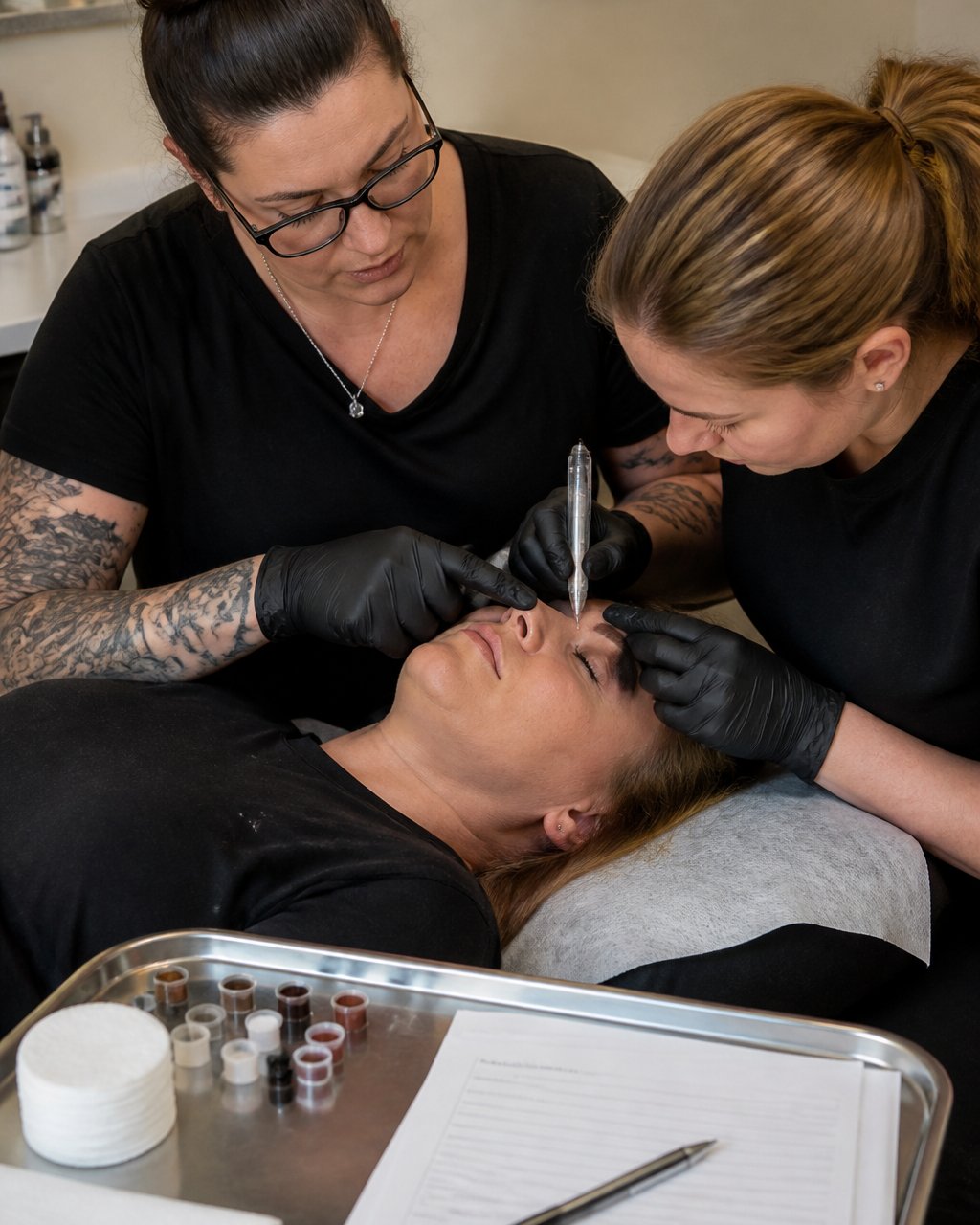
A common mistake is choosing a program with a high student-to-model ratio. If one instructor supervises too many students at once, corrections get rushed. Ask how many models you personally work on and who supplies them.
For a deeper look at mastering techniques through supervised practice, read our guide to PMU techniques with live model practice.
Online Permanent Makeup Training: What It Can and Cannot Replace
Online permanent makeup training works well for the classroom portion: anatomy, color theory, sanitation protocols, and business setup. It cannot replace supervised needle work on live models, because no state health department accepts a video demonstration as proof of hands-on competency.
The practical split looks like this. Theory, bloodborne pathogens coursework, and client consultation scripts translate cleanly to video. Machine handling, needle depth, and correction of uneven results require an instructor standing next to you.
Our online permanent makeup training guide covers which modules genuinely work remotely and which ones you should refuse to learn from a screen.
How Long Does It Take to Learn PMU and Build a Client Base?
How long it takes to learn PMU depends on format and state rules, but most practitioners need several months of training plus a touch-up cycle before results stabilize. Foundational programs typically run a short intensive block, while apprenticeship routes stretch longer.
Building a client base takes additional time. New artists usually spend the first year refining technique on a small roster, photographing healed results, and collecting reviews. Healed photos matter more than fresh ones, because pigment settles and shifts over the first weeks.
Plan for continuing education too. Advanced training in powder brows, lip blush, and correction work expands your service menu once fundamentals are solid.
Choosing a Certification Program: Curriculum, Cost, and Verification
Choosing a certification program comes down to three checks: what the curriculum covers, what the total cost includes, and whether the credential can be verified. A legitimate program publishes its hours, its technique list, and its instructor credentials, and it will answer cost questions in writing before you pay a deposit.
Curriculum and competency benchmarks. A transparent program breaks training into theory, supervised practice, live-model work, and assessment, and it states minimum competency standards rather than promising a certificate for attendance.
Insurance and post-course obligations. Malpractice coverage for cosmetic tattooing is usually a separate policy from standard esthetics insurance, and most carriers ask for proof of training before issuing it.
Run through this checklist before you pay a deposit:
- Curriculum lists fundamental and advanced techniques, including microblading, powder brows, lip blush, and eyeliner
- Live-model hours are specified, with student-to-instructor ratio disclosed
- Bloodborne pathogens and infection control training is included or required
- Instructor holds a current master-level credential and can document it
- Tuition breakdown covers kit, models, licensing fees, and any retake policy
- Certificate is verifiable through a recognized body, such as the American Academy of Micropigmentation
- Post-course support and mentorship terms are in writing
Verification. Contact the certifying body directly and confirm your instructor's standing. Accreditation claims are easy to print and easy to check. You can explore PMU certification courses to see the formats available.
Frequently Asked Questions
Can licensed estheticians perform permanent makeup?
In most states, a standard esthetician license does not authorize permanent makeup. PMU involves breaking the skin with needles, which falls under tattoo or body-art regulations. Licensed estheticians typically need a separate permanent makeup certification and, depending on the state, a body-art or tattoo license. Some states allow estheticians to perform microblading or powder brows with additional training, while others require a full tattoo establishment license. Check your state cosmetology board and local health department rules before enrolling in training.
What do permanent makeup certification requirements usually include?
Most programs require a current esthetician or cosmetology license, a high school diploma or equivalent, and completion of a bloodborne pathogens course. You will also need to show proof of hands-on training hours, which commonly range from 40 to 100 hours depending on the state. Many schools ask for a portfolio review or an entrance interview. Some states require an exam and a formal apprenticeship. Always confirm that the program meets your state's specific hour and curriculum rules before you pay tuition.
Does PMU training with live models actually matter?
Yes. Working on live models is where you learn to manage skin types, bleeding, pigment retention, and client comfort, none of which a video can teach. Most state licensing boards require documented live-model procedures before you can apply for a license. Look for a program that supplies models and supervised practice, not one where you must find your own. A strong program will also teach consent, aftercare instructions, and documentation, which protect you and your clients.
Can you learn permanent makeup online?
Online courses can cover theory, color theory, sanitation, and business setup, but they cannot replace supervised hands-on practice. Most states will not license you based on an online course alone. A blended approach works best: complete the classroom or online theory portion, then finish in-person training with live models. If a program promises full certification without any hands-on component, verify it with your state board before enrolling. Online permanent makeup training is a supplement, not a substitute for practical hours.
How long does it take to learn PMU and start working?
A foundational PMU certification typically takes two to six weeks of full-time training, or several weekends. After certification, most artists spend three to six months practicing on models and building a portfolio before charging full rates. Advanced techniques such as powder brows, lip blush, and scalp micropigmentation each add training time. Your pace also depends on your state's licensing timeline, which can add weeks or months for application review and exams.
How do I verify a permanent makeup certification program is legitimate?
Check three things: whether the school is approved by your state board, whether the instructor holds a current master-level certification from a recognized body such as the American Institute of Intradermal Cosmetics, and whether the curriculum includes bloodborne pathogens training, live-model hours, and aftercare. Ask for the names of recent graduates and look at their healed work, not just fresh photos. A legitimate program will give you documentation you can submit to your health department without extra steps.