
 ultimate-guide
Can You Learn Permanent Makeup Online? 2026 Guide
Table of Contents
- Can You Learn Permanent Makeup Online? The Honest Answer
- Permanent Makeup Certification Requirements and State Regulations
- PMU Training Duration: What to Expect From Start to Certification
- How Online PMU Courses Work (And Where They Fall Short)
- Best Practices for Learning Microblading and PMU Techniques
- PMU Starter Kit Essentials for New Technicians
- The Hybrid Model: Blending Online Theory With In-Person Clinical Hours
- Career Path and Professional Development After Certification
- Frequently Asked Questions
Last Updated: October 4, 2026
Can You Learn Permanent Makeup Online? The Honest Answer
Yes, you can learn permanent makeup online, but it requires hands-on clinical training to be complete. The most successful artists combine digital curriculum with real-world practice under expert supervision.
Online courses deliver comprehensive theory on pigment science, skin anatomy, color theory, and safety protocols efficiently. But theory alone won't make you a technician, the gap between understanding technique and executing it on a live client is where online-only training falls short.
Professionals master hands-on practice with feedback from a master instructor. The hybrid model, combining online learning with in-person clinical hours, has become the industry standard because it produces technicians ready for professional practice.
Permanent Makeup Certification Requirements and State Regulations
Certification requirements vary dramatically by state. There's no federal PMU licensing board, so each state sets its own rules. Understanding your state's requirements before enrolling is essential.
State Regulatory Categories
States fall into roughly four categories:
Regulated as a cosmetology service: States like California, Florida, and New York require PMU practitioners to hold a cosmetology or specialized PMU license. These states typically mandate 100-300 hours of formal training through an accredited program, bloodborne pathogens certification, and passage of a state exam.
Regulated as a medical procedure: States like Massachusetts classify PMU as a medical procedure requiring supervision by a licensed physician or nurse. Online training alone is insufficient; you must work under direct medical oversight.
Regulated through health department guidelines: States like Colorado and Oregon have health department rules for bloodborne pathogens and sanitation but no formal PMU licensing. You can legally practice but must comply with bloodborne pathogens standards and ensure your program covers your state's requirements.
Unregulated: States like Montana and Wyoming have no formal PMU regulations. Operating without regulation means no legal protection if a client sues and limited insurance coverage. Many practitioners voluntarily pursue certification from organizations like the American Institute of Intradermal Cosmetics (AIIC) or the American Academy of Micropigmentation (AAM) to establish professional standards.
How to Verify Your State's Requirements
Don't assume an online program meets your state's standards. Contact your state's cosmetology board or health department directly and ask: Is PMU regulated? What are the minimum training hours? Does training need to be in-state? Request regulations in writing. Nearly every state requires current bloodborne pathogens certification (typically through the American Red Cross), renewed every 1-3 years.
Professional Standards Beyond Legal Requirements
Reputable programs align with standards set by the American Institute of Intradermal Cosmetics and the American Academy of Micropigmentation. Accredited programs typically require 200-500 hours of combined online and in-person training, comprehensive modules on skin anatomy and pigment chemistry, hands-on clinical hours under direct supervision, current bloodborne pathogens certification, and documented client consent and aftercare protocols. Choosing a program aligned with these standards protects your reputation and ensures you're learning current best practices.
The Hybrid Model and State Compliance
The hybrid model is designed to satisfy state requirements across different regulatory environments. Before enrolling, confirm the in-person component meets your state's specific hour requirements. Proper certification prevents legal and financial problems later.
PMU Training Duration: What to Expect From Start to Certification
Most comprehensive PMU training programs run 200-500 hours depending on techniques covered and state requirements. A basic microblading course takes 100-150 hours; adding powder brows and lip blushing extends that to 300-400 hours. Compressed programs promising certification in 2-3 weeks are red flags. Quality training requires time for theory absorption, practice repetition, and feedback integration. Most hybrid programs structure as 4-6 weeks of online curriculum followed by 2-4 weeks of in-person clinical training.
How Online PMU Courses Work (And Where They Fall Short)
Digital Curriculum and Theory
Online PMU courses deliver theory through video modules, downloadable guides, and interactive assessments covering skin anatomy, color theory, and business fundamentals. You can rewatch lessons and study frame-by-frame, making complex theory accessible. Quality programs include modules on client consultation, sanitation protocols, legal requirements, and business basics like pricing and marketing.
The Hands-On Practice Gap
You cannot learn proper needle angle, pressure control, or real-time decision-making from a screen. A mannequin doesn't bleed or have variable skin texture; live models do. An instructor watching you work catches problems video assessments can't, improper device angle, excessive pressure, or unexpected skin responses. Video submissions help but don't replace real-time correction.
Best Practices for Learning Microblading and PMU Techniques
Artists who progress fastest combine disciplined self-study with practice under expert observation. Master fundamentals first: eyebrow mapping on paper, skin type assessment, pigment color selection, and needle configuration. Different needle arrangements create different effects; using the wrong one wastes practice time.
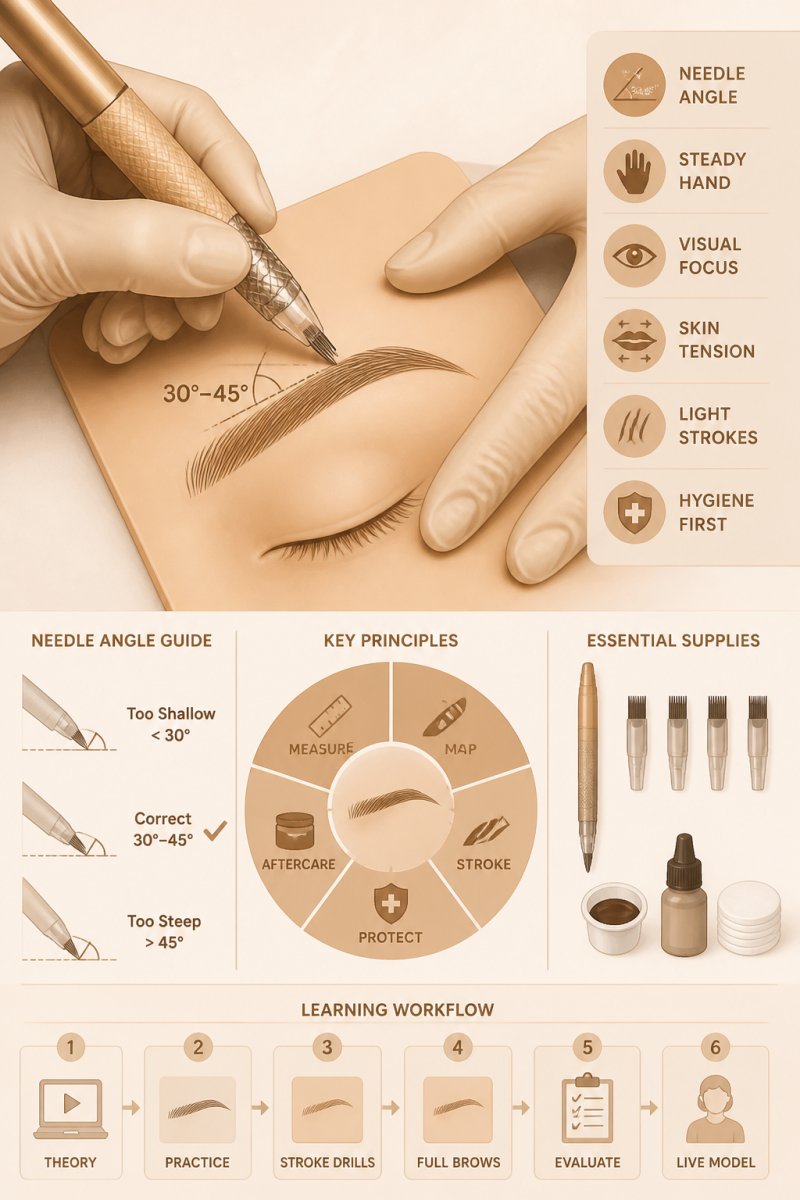
Practice on mannequins before touching a live model, aim for 50-100 practice strokes per technique before your first paid client. One bad eyebrow on a real person takes months to correct. Keep detailed notes on every session to build pattern recognition. Invest in quality starter kits early; cheap equipment teaches bad habits and costs you months of wasted practice. Find a master instructor who demands precision and won't let you move forward until you've mastered each step.
PMU Starter Kit Essentials for New Technicians
Your starter kit determines whether you develop good technique or bad habits. You'll need a reliable PMU device (rotary or electromagnetic) that maintains consistent needle depth and speed. Start with needle configurations for microblading and powder brows. Quality pigments are non-negotiable; budget pigments have poor retention and oxidation risk. Include proper sanitation supplies, a practice mannequin with replaceable skin, and business essentials: intake forms, consent documents, aftercare instructions, and a portfolio system.
The Hybrid Model: Blending Online Theory With In-Person Clinical Hours
The hybrid approach is the industry standard because it solves a fundamental problem: online-only training leaves students unprepared for live client work, while full-time apprenticeship is impractical for most people. The hybrid model compresses learning time while ensuring genuine hands-on competency.
How Hybrid Programs Structure Learning
A typical hybrid program divides training into three phases:
Phase 1: Online Curriculum (4-8 weeks) You complete digital modules covering skin anatomy, pigment chemistry, color theory, safety protocols, sanitation standards, and business fundamentals. Quality programs include video demonstrations, downloadable guides, quizzes, and instructor access via email. This phase covers skin structure, pigment composition, needle configurations, client consultation, bloodborne pathogens compliance, pricing, marketing, and legal liability. You can rewatch lessons as needed and study on your schedule without paying for instructor time.
Phase 2: In-Person Clinical Training (2-4 weeks, intensive) You attend in-person sessions where a master instructor guides your hands-on work. This is where technique truly develops. The in-person component typically follows this progression:
Week 1: Mannequin Practice Under Supervision You perform dozens of practice strokes on synthetic skin while your instructor watches and adjusts your needle angle, pressure, and hand position. The goal is muscle memory and pattern recognition. An instructor watching your hands catches problems before they become habits, improper pressure or device angle that would cause uneven strokes.
Week 2-3: Live Model Practice You transition to live models. Real skin bleeds, has variable texture, and clients react to the needle. Your instructor observes every procedure, guiding you through unexpected skin responses, teaching you to read feedback and adjust in real-time, and showing you how to manage client anxiety and complications. Most programs require 10-30 live procedures under supervision, documented with photos, consent forms, and instructor notes.
Phase 3: Post-Course Mentorship (3-6 months, optional but recommended) Many instructors offer ongoing mentorship where you submit photos for feedback or schedule check-ins to discuss challenging cases. This is critical because your first 50-100 clients will teach you more than any course. A mentor available during this phase accelerates learning and prevents bad habits.
Evaluating Hybrid Programs: What to Look For
Not all hybrid programs are created equal. When comparing options, assess these factors:
Instructor Credentials Verify that your instructor has at least 5+ years of professional PMU experience, certification from recognized organizations (AIIC, AAM, or equivalent), a portfolio of professional work, current bloodborne pathogens certification, and liability insurance. Ask for references from past students and contact them directly.
In-Person Component Structure Confirm the in-person component includes minimum 40-80 hours of supervised hands-on practice, progression from mannequin to live models, real-time feedback during procedures, documentation of every procedure with photos and notes, and clear expectations about live procedure count.
State Compliance Alignment Confirm the program's online + in-person hours meet your state's requirements. If your state requires accreditation, verify the program holds it from a recognized body.
Equipment and Materials Provided Confirm whether the program provides practice devices, quality pigments, sterile supplies, and a practice mannequin. Some include these in tuition; others require separate purchase. Confirm costs upfront.
Post-Course Support Ask about mentorship availability, photo feedback, check-ins for challenging cases, and graduate communities. Post-course support is invaluable during your first year of independent practice.
The Hybrid Model vs. Pure Online vs. Full-Time Apprenticeship
Understanding the trade-offs helps you choose the right path:
Pure Online Training
- Pros: Lowest cost, maximum flexibility, comprehensive theory
- Cons: No hands-on feedback, no live client experience, high risk of developing bad habits
- Best for: People with prior hands-on experience in related fields (nursing, esthetics) or those willing to find a separate mentor for hands-on training
Hybrid Training
- Pros: Balanced cost, flexible online component, intensive hands-on training, instructor feedback, state-compliant structure
- Cons: Requires time off work for in-person sessions, moderate cost
- Best for: Most aspiring PMU technicians; this is the industry standard for good reason
Full-Time Apprenticeship
- Pros: Comprehensive hands-on training, daily feedback, professional network building, potential to earn while learning
- Cons: Highest time commitment, lower pay during apprenticeship, limited flexibility, dependent on finding a quality mentor
- Best for: People who can afford reduced income for 6-12 months and have access to an established artist willing to mentor
The hybrid model balances cost, time, and learning outcomes. It's why it's become the industry standard.
Career Path and Professional Development After Certification
PMU certification is a beginning, not an ending. Your first 50-100 clients will teach you more than any course. Many successful technicians pursue advanced certifications like scalp micropigmentation or color correction. Professional development doesn't stop; the industry evolves and the artists who stay current attend masterclasses and invest in ongoing training.
Learning permanent makeup online is absolutely possible, but success requires honest assessment of what online education can and cannot deliver. Theory and technique foundation come from quality digital curriculum. Mastery comes from hands-on practice under expert guidance.
If you're serious about becoming a PMU technician, invest in a program that combines both. Look for instructors with genuine experience and credentials from recognized organizations like the American Institute of Intradermal Cosmetics. Verify your state's requirements before enrolling.
Frequently Asked Questions
What type of license do you need to do permanent makeup?
License requirements vary by state. Some states regulate PMU under cosmetology or esthetics licenses, while others have separate permanent cosmetics permits. Washington State requires bloodborne pathogens certification and compliance with state board regulations for anyone performing cosmetic tattooing. Before enrolling in training, verify your state's specific requirements with your state's health department or cosmetology board to ensure your certification will be recognized professionally.
Does online PMU training include hands-on practice?
Most online permanent makeup courses focus on theory, anatomy, pigment theory, color correction, and digital curriculum. True hands-on practice with live models or mannequins typically requires in-person clinical hours at an academy or through apprenticeship. This is why many aspiring artists use a hybrid model: completing online coursework for foundational knowledge, then attending in-person sessions with a master instructor for technique mastery and supervised practice with actual clients.
Can you be a self-taught permanent makeup artist?
Self-taught PMU artists face significant barriers. Most states require formal certification, clinical hours logged under supervision, and proof of bloodborne pathogens training before you can legally perform permanent makeup on clients. Additionally, professional development in this field demands hands-on mentorship to master eyebrow mapping, shading techniques, needle configuration, and sanitation protocols. Working with an established academy or master instructor is the standard path to building a credible portfolio and career advancement.
How long does permanent makeup training take?
PMU training duration depends on your program structure. Online theory courses may take 4-12 weeks, but adding in-person clinical hours and apprenticeship typically extends the timeline to 3-6 months or longer. Full-time intensive programs at accredited academies may compress this, while part-time hybrid learning allows busy professionals to complete training alongside work. Total time varies based on state requirements, the number of live model practice hours mandated, and your learning pace.