 comparison
Beginner vs Advanced PMU Training Courses
Table of Contents
- Beginner vs Advanced PMU Training Courses: Key Differences
- PMU Course Prerequisites and Readiness
- PMU Training Duration and Time Investment
- Online PMU Course vs In-Person Training: Which Path Fits Your Goals
- PMU Hands-On Training and Live Model Practice
- When to Move From Beginner to Advanced Permanent Makeup Training
- Evaluating Course Quality and Measurable Outcomes
- Frequently Asked Questions
Last Updated: October 12, 2026
Beginner vs Advanced PMU Training Courses: Key Differences
Choosing between beginner and advanced PMU training courses isn't just about skill level, it's about your starting point, goals, and what you're ready to learn.
Beginner PMU training courses teach foundational techniques, safety protocols, and basic application methods. You'll learn foundational techniques like microblading, powder brows, and introductory lip tint work. Advanced PMU training courses build on that foundation with complex correction work, specialized techniques like ombre brows, advanced lip blush applications, and business scaling strategies.
The real distinction is prerequisites. Beginner courses assume you're starting from zero; advanced courses assume hands-on experience, skin anatomy knowledge, confident pigment mixing, and procedures on multiple clients.
In practice: a beginner course teaches you to hold a machine and apply pigment safely. An advanced course teaches you to fix bad microblading, work with different skin types and tones, and handle mid-procedure complications.
PMU Course Prerequisites and Readiness
Before enrolling, assess where you stand. Beginner courses typically require only a high school diploma and genuine interest, sometimes a minimum age of 18, prerequisites are minimal because they start from scratch.
Advanced PMU training courses have real gatekeeping: most reputable programs require a beginner certification or equivalent hands-on experience, some ask for proof of 50-100 procedures on live clients, and others require a portfolio.
The reason is practical: advanced instructors can't spend time on how to hold a machine or why needle depth matters. They assume those fundamentals so they can focus on nuanced real-world problems.
Consider these readiness markers before applying to advanced training:
- You've completed a beginner PMU course or equivalent certification program
- You've performed a significant number of procedures on live clients (not just practice models)
- You understand skin anatomy well enough to identify skin types and adjust your technique accordingly
- You can troubleshoot common problems: pigment migration, uneven color distribution, client discomfort during procedures
- You have a portfolio of before-and-after photos from your own work
- You're comfortable with color theory and can mix custom pigments for different skin tones
If you're missing most of these, start with a beginner course regardless of how experienced you feel, the best advanced training builds on solid fundamentals.
PMU Training Duration and Time Investment
Duration varies dramatically between beginner and advanced programs and is widely misunderstood.
Beginner PMU training typically runs 3-7 days in person, or 2-4 weeks part-time online. In-person intensives cover theory, live demos, hands-on model practice, and sanitation in a compressed timeframe; online courses move slower because video and self-paced modules require more repetition.
Advanced PMU training is usually shorter, often 2-5 days, but far denser, covering specialized techniques, correction strategies, and business scaling at a pace that assumes you already know the fundamentals.
The critical detail: calendar duration isn't time investment. A 3-day beginner course might require 30+ hours including pre-course reading and post-course practice; a 5-day advanced course might involve 40+ hours of high-density instruction.
Plan for additional practice either way. Beginner graduates typically need 2-3 months of supervised practice on live models before working on paying clients; advanced graduates may handle complex cases within 2-4 weeks thanks to existing muscle memory.
| Course Type | Calendar Duration | Total Study Hours | Post-Course Practice | Ready for Clients |
|---|---|---|---|---|
| Beginner (In-Person) | 3-7 days | 30-40 hours | 2-3 months | 3-4 months |
| Beginner (Online) | 2-4 weeks | 35-50 hours | 3-4 months | 4-5 months |
| Advanced (In-Person) | 2-5 days | 35-45 hours | 2-4 weeks | 1-2 months |
| Advanced (Online) | 1-3 weeks | 25-35 hours | 3-6 weeks | 2-3 months |
Time investment affects cash flow: if you're leaving a job to train full-time, a beginner course gets you to income-generating work faster; if you're training part-time, an online beginner course spreads the commitment over weeks.
Online PMU Course vs In-Person Training: Which Path Fits Your Goals
This choice often determines whether you complete training and feel confident on real clients.
In-person PMU training gives immediate instructor feedback: you see how they hold the machine, feel the pressure, and ask questions in real time.
The tradeoff: you must be physically present, often in a specific location, paying for travel, accommodation, and time away. The schedule is fixed, you attend when the course runs, not when it's convenient.
Online PMU training offers flexibility: learn on your schedule, pause when needed, and rewatch videos freely.
The tradeoff: online training requires self-discipline and offers no real-time technique feedback, you can't feel the instructor's hand position or ask questions in the moment.
In-person training is better for building muscle memory and confidence on live clients. If you're serious about PMU as a career, it pays off with better first-client results, better reviews, and faster business growth.
Online training is better if you're exploring PMU or can't attend in person. You learn theory and practice on synthetic models, and many programs now offer optional in-person intensives for live feedback, a hybrid balancing flexibility with hands-on learning.
Advanced training almost always happens in-person because the corrective work and complex techniques require real-time feedback. You can't learn to fix someone's botched microblading through a video.
PMU Hands-On Training and Live Model Practice
This is where the real learning happens, and where beginner and advanced training diverge most sharply.
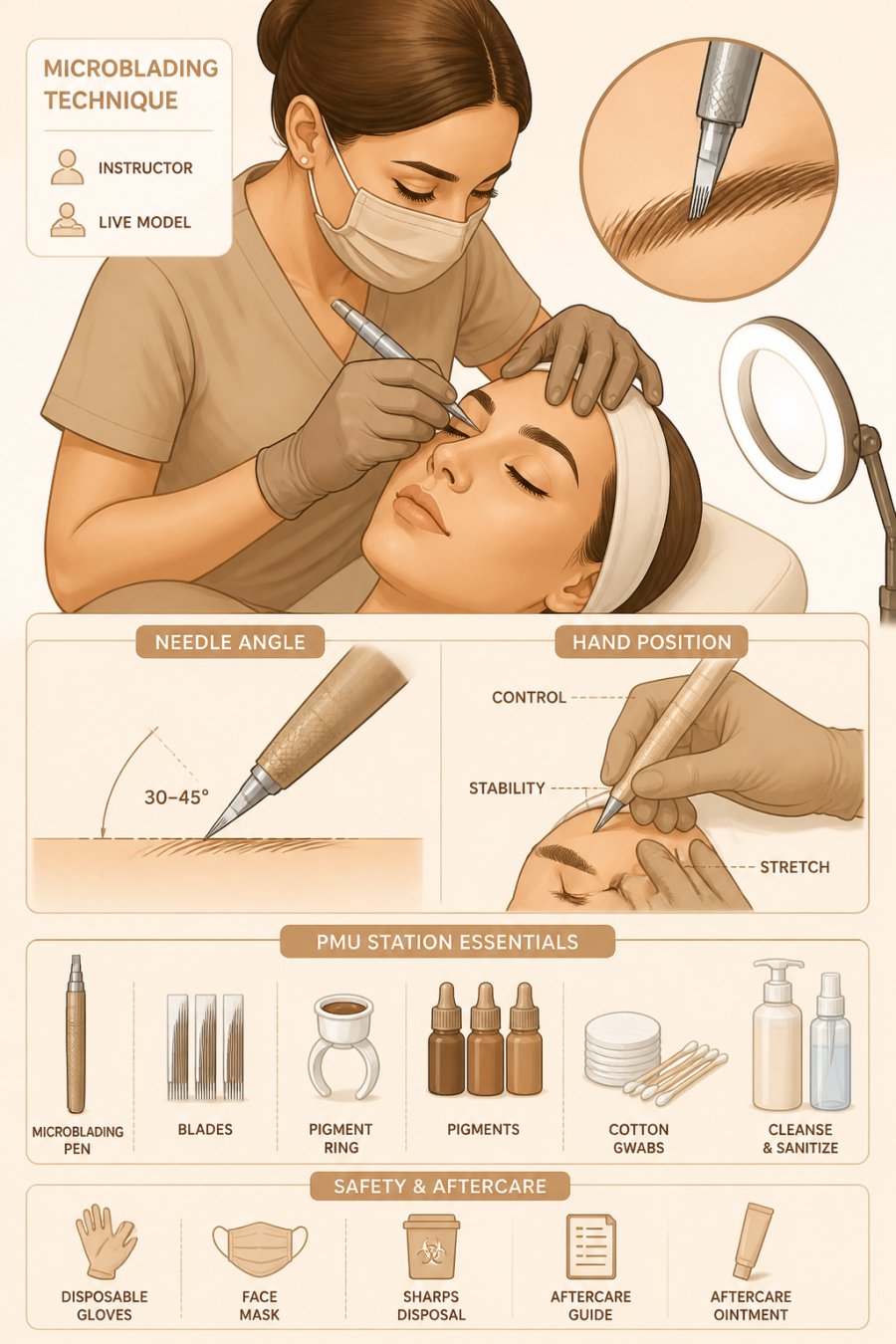
Beginner training includes supervised practice on synthetic skins and at least one live model session, usually 30-60 minutes.
The goal isn't perfect results but muscle memory and understanding how skin responds to the needle, expect to redo sections and learn from mistakes in real time.
Advanced training involves multiple live models on complex cases: oily skin requiring different needle depth than dry, correcting previous microblading by understanding the prior artist's choices, or working with sensitive skin from conditions like alopecia.
Practice is longer and more intensive because you're solving problems, not just applying pigment. Instructors ask you to explain color choices, brow mapping, and technique adjustments, assessing your decision-making, not just your hands.
Live model practice is critical in both paths because synthetic skin doesn't bleed, react to pressure, or move.
Most reputable advanced programs require multiple live models during training; beginner programs typically require 1-3 sessions, reflecting the difference in complexity.
When to Move From Beginner to Advanced Permanent Makeup Training
Timing matters: move too early and you'll struggle without foundational knowledge; too late and you'll waste money on material you've mastered.
The standard guideline is: complete a beginner course, perform a significant number of procedures on real clients, and take honest feedback from your work before enrolling in advanced training.
That's roughly how long it takes to stop thinking about mechanics and trust your hands. With sufficient practice, you'll become smoother, see patterns in what works, and experience enough variation in skin types, preferences, and healing outcomes to truly understand the work.
Some signs you're ready for advanced training:
- You've completed a beginner certification and have documented proof
- You have a portfolio of before-and-after photos from procedures you've performed
- You can explain why you made specific decisions (brow shape, color choice, needle depth) for different clients
- You've had at least one difficult client situation and solved it (color not taking, asymmetrical healing, client dissatisfaction) and learned from it
- You're confident in your sanitation and safety protocols, they're automatic, not something you have to think about
- You want to specialize (corrective work, advanced techniques like ombre brows, specific client populations like medical patients)
Some signs you're not ready yet:
- You've completed a beginner course but haven't performed procedures on real clients yet
- You have fewer documented procedures
- You're still uncertain about basic color theory or skin anatomy
- You haven't experienced a complication or client issue and worked through it
- You're hoping advanced training will teach you things you should have learned in beginner training
Advanced training assumes consistent, solid beginner work. If your basics are shaky, advanced training will feel overwhelming, you'd be building on an unstable foundation.
Evaluating Course Quality and Measurable Outcomes
Not all beginner and advanced PMU training courses are equal: some are rigorous, others are cash grabs certifying people who aren't ready for clients.
Here's how to evaluate whether a course will actually prepare you:
Look for documented learning outcomes. "You'll master microblading" is vague; "perform microblading on three live models under supervision, demonstrate needle depth on synthetic skin, and pass a sanitation exam" is specific and measurable.
Check instructor credentials. Look for instructors with significant real-world PMU experience and active certifications from recognized organizations like the American Institute of Intradermal Cosmetics or American Academy of Micropigmentation.
Ask about the live model component. How many models, how much time each, and is an instructor present throughout?
Request student outcomes data. What percentage of graduates work professionally within 6 months? What's the average starting income? Do graduates feel confident on first clients?
Look for post-course support. Is there mentorship after graduation, instructor access for questions, or a graduate community? Quality programs don't abandon you at graduation.
Check for continuing education. PMU techniques, pigments, machines, and safety protocols evolve. Continuing education or refresher courses signal instructors stay current and expect graduates to do the same.
Verify certification recognition. Is it recognized by state regulatory bodies or professional organizations?
At Tonni Petty PMU Artistry, we emphasize one-on-one training with a Master Instructor.
Choosing between beginner and advanced PMU training is ultimately about honesty. Beginner training builds the foundation for a sustainable career; advanced training accelerates growth once you've mastered the basics.
Frequently Asked Questions
What is the difference between beginner and advanced PMU training?
Beginner PMU training courses cover foundational skills: skin anatomy, color theory, pigment selection, brow mapping, symmetry, and basic technique execution across treatments like microblading, powder brows, and lip blush. Advanced training assumes you've mastered these fundamentals and focuses on technique refinement, speed, consistency, corrective work, troubleshooting complex cases, and specialized applications like ombre brows and combo brows. Advanced courses typically include live demonstrations of advanced shading methods and hands-on practice with challenging skin types.
Do you need experience before taking an advanced PMU course?
Yes. Most reputable advanced PMU training programs require you to complete a beginner certification or demonstrate existing professional experience with permanent makeup. Some academies ask for a portfolio of your work or proof of client experience. This prerequisite ensures you understand fundamental concepts like machine control, needle technique, and sanitation protocols before moving into advanced applications. Without this foundation, advanced training becomes difficult to absorb and apply safely.
Can you learn permanent makeup online, or do you need hands-on training?
PMU training works best with a blend of both. Online courses efficiently deliver theory, color theory, brow mapping principles, and video demonstrations of technique. However, hands-on practice with live models is essential for developing precision, consistency, and the muscle memory required for safe needle control and shading. Many hybrid programs combine online learning with in-person sessions or require you to practice on models under supervision. Pure online-only training without any hands-on component limits your ability to master the practical skills clients expect.
How long does it take to learn permanent makeup from beginner to professional level?
Beginner PMU certification typically requires a significant number of hours of training, depending on the academy and curriculum depth. This includes classroom instruction, video content, and hands-on practice with live models. Advanced training adds additional hours. Total time to professional readiness varies, depending on whether you train full-time or part-time. Post-course mentorship and continued practice with real clients further develop your speed and consistency over your first year of professional work.
When should I move from beginner to advanced PMU training?
Move to advanced training once you've completed your beginner certification, built a portfolio of healed client results, and can execute basic techniques consistently without guidance. You should feel confident with brow mapping, machine control, and sanitation protocols. If you're still struggling with symmetry, pigment saturation, or client communication, spend more time practicing before advancing. Advanced training teaches refinement and specialty techniques, not foundational skills, so rushing the transition wastes both time and money.