
 ultimate-guide
Permanent Makeup Training for Beginners in Washington
Table of Contents
- What Washington Requires Before You Start Permanent Makeup Training
- How Long Is Permanent Makeup Training in Washington?
- Can You Learn Permanent Makeup Online? What Works and What Doesn't
- Core Curriculum: From Skin Anatomy to Needle Depth Control
- What Beginner Permanent Makeup Training Costs and Includes
- Building Your Portfolio and Launching Your PMU Career
- Conclusion: Your Next Step Toward Certification
- Frequently Asked Questions
Last Updated: September 9, 2026
What Washington Requires Before You Start Permanent Makeup Training
Permanent makeup training for beginners in Washington is regulated more strictly than in many other states, and the first requirement is not a certificate of completion. The Washington State Department of Licensing (DOL) classifies permanent makeup, including microblading, machine shading, lip blushing, and areola tattooing, as tattooing. That means you must hold a tattoo operator license before you can legally work on clients, and that license hinges on completing a bloodborne pathogens training course approved by the Department of Health.
The Step-by-Step Legal Path to Compliance
The regulatory path in Washington is often confusing because the state does not issue a separate "permanent makeup license" or "microblading license." Instead, the DOL's tattoo operator license covers all forms of micropigmentation. Here is the sequence most beginners must follow:
-
Complete a Department of Health-approved bloodborne pathogens course. This is your first step, and it cannot be skipped. The course covers OSHA bloodborne pathogens standards, hepatitis B and HIV transmission prevention, proper hand hygiene, personal protective equipment (PPE) use, and safe handling of sharps. Most approved courses take 4 to 8 hours and cost between $50 and $150. The Washington State Department of Health bloodborne pathogens training guidelines list approved providers, and you must keep your certificate on file.
-
Complete a formal tattoo training program. Washington does not prescribe a specific hour count for tattoo training, but the DOL expects applicants to demonstrate competency through a combination of classroom instruction and supervised practical work. A structured permanent makeup program that includes both theory and hands-on practice on live models satisfies this expectation.
-
Pass the Washington state tattoo operator written and practical exams. These exams are administered through a third-party testing provider, not the DOL itself. The written exam covers infection control, sterilization, sanitation, and legal responsibilities. The practical exam requires you to demonstrate proper setup, glove changes, needle disposal, and a simulated procedure on a practice surface while an evaluator observes your technique.
-
Apply for your tattoo operator license through the DOL. Once you pass both exams, you submit your application, proof of bloodborne pathogens training, exam scores, and the applicable fee. The DOL reviews your application and issues your license, which you must renew periodically.
The Microblading vs. Tattoo License Confusion
A common point of confusion among beginners is whether microblading, which uses a manual hand tool rather than a machine, falls under the tattoo operator license. It does. Washington's definition of tattooing includes any insertion of pigment into the skin for cosmetic purposes, regardless of the tool used. This means there is no separate "microblading exemption" in Washington, unlike some other states. Practitioners who operate without the tattoo operator license risk fines, cease-and-desist orders, and liability if a client experiences complications.
Why This Regulatory Foundation Matters for Beginners
At Tonni Petty PMU Artistry, we emphasize this regulatory foundation because it separates serious practitioners from those who operate informally. Before you book any training program, verify that the school's curriculum aligns with the DOL's expectations for the state board exam, otherwise, you may finish your course only to discover gaps in your preparation.
How Long Is Permanent Makeup Training in Washington?
A comprehensive beginner program typically runs between 100 and 200 hours of combined theory and hands-on instruction, spread across three to six weeks. This range reflects the difference between accelerated courses that focus narrowly on one technique and full curricula that prepare you for a sustainable career.
Most reputable training programs break down as follows:
- Theory and anatomy modules: 20-40 hours
- Hands-on practice on synthetic skin and models: 60-120 hours
- Business and safety instruction: 20-40 hours
The question of how long is permanent makeup training depends heavily on whether you enter with prior experience in a related field. A licensed esthetician or cosmetologist often completes training faster because they already understand skin anatomy and sanitation, whereas a complete beginner needs additional time to build those fundamentals.
Can You Learn Permanent Makeup Online? What Works and What Doesn't
You can learn the theoretical components of permanent makeup online, but you cannot complete the hands-on practicum required for certification through a screen. Online courses are valuable for mastering pigment theory, color correction, skin anatomy, and aftercare protocols, but the state of Washington requires demonstrated practical skill for licensing.
What works well online:
- Color theory and pigment selection
- Skin anatomy and depth control principles
- Sanitation and OSHA compliance standards
- Business practices and client consultation frameworks
What does not work online is the physical application. Needle configuration, machine handling, and the subtle pressure control required for microblading simply cannot be assessed through video. A common mistake among beginners is assuming that watching demonstrations equals skill acquisition, only to struggle on their first real client. The permanent makeup training path that produces confident artists always includes supervised practice on live models.
Core Curriculum: From Skin Anatomy to Needle Depth Control
A professional curriculum for permanent makeup training begins with skin anatomy because every technical decision, from needle depth to pigment selection, depends on understanding the layers of the dermis. You will learn how pigment behaves in different skin types, why certain strokes heal softly while others blur, and how to adjust your approach for aging or sensitive skin.
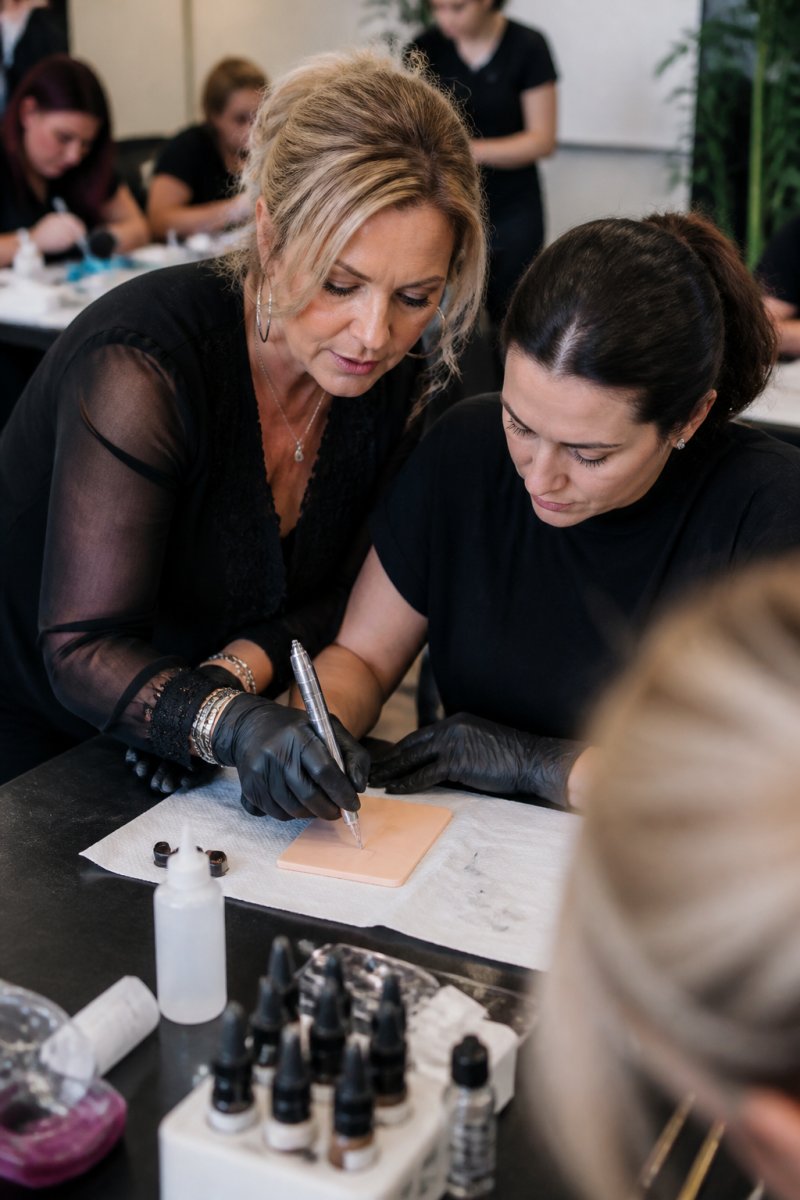
The practical component is where theory becomes muscle memory. Students practice on synthetic skins first, then transition to live models under direct supervision. Depth control is the skill that most distinguishes a safe artist from a dangerous one: too shallow and the pigment fades quickly, too deep and you risk scarring and pigment migration.
Hand Method vs. Machine: Microblading and Shading Techniques
The hand method, used for microblading, creates fine hair strokes that mimic natural brow hairs, while machine techniques produce powder brows, ombre shading, and lip blushing. Both methods require distinct needle configurations and pressure control, and a well-rounded training program teaches both rather than forcing a specialty too early.
What Beginner Permanent Makeup Training Costs and Includes
Tuition for beginner permanent makeup training in Washington varies widely based on the depth of the curriculum, the instructor's credentials, the student-to-teacher ratio, and whether a starter kit is included. Tuition for beginner permanent makeup training in Washington varies widely based on the depth of the curriculum, the instructor's credentials, the student-to-teacher ratio, and whether a starter kit is included.
What a Typical Tuition Breakdown Looks Like
When you receive a quote from a training provider, ask for an itemized breakdown. A transparent program should account for the following components:
- Instruction time: $50 to $150 per hour of one-on-one instruction, with group courses often priced lower per hour but offering less personalized feedback.
- Starter kit: $500 to $1,500, depending on whether it includes a professional-grade machine, pigment sets, practice skins, needles, numbing agents, and aftercare products. Some programs include the kit in tuition; others charge it separately.
- Live model practice: Some schools charge an additional fee for arranging live models, typically $100 to $300 per session. Others include a set number of live model sessions in the base tuition.
- Exam preparation materials: $100 to $300 for practice tests, study guides, and mock practical evaluations.
- Certificate of completion: This should be included in tuition, but confirm that the certificate is recognized by the Washington State Department of Licensing.
Red Flags and What to Watch For
Not all training programs are created equal, and the cheapest option often leaves you unprepared for the state board exam. Watch for these warning signs:
- No live model requirement: If a program only has you practice on synthetic skin, you will not develop the confidence or skill to work on real clients. Washington's practical exam expects you to demonstrate technique on a simulated procedure, but real-world success requires supervised work on human skin.
- Hidden fees: Some schools advertise a low base price, then add charges for pigments, needles, practice skins, and even the certificate itself. Ask for a complete list of what is and is not included before enrolling.
- Oversized class sizes: A course with 15 or more students and a single instructor means you will receive minimal hands-on guidance. Look for programs with a student-to-teacher ratio of 4:1 or better.
- No post-course support: Training that ends at graduation leaves you to troubleshoot healing complications, color corrections, and difficult skin types alone. Ask whether the instructor offers follow-up consultations, either in person or virtually, after you begin working on clients.
Financing Options and Payment Plans
Many training providers offer payment plans that split tuition into monthly installments, often with a deposit required to reserve your seat. Some students use personal savings, while others explore financing through third-party education lenders or credit cards with promotional 0% APR periods. If you are currently employed in a related field, check whether your employer offers professional development reimbursement. The investment in quality training can be significant.
What to Look for in a Tuition Breakdown
Before you commit to any program, request a written breakdown that includes:
- A starter kit with practice skins, pigments, and basic tools
- Live model practice sessions beyond synthetic skin work
- Instruction in both microblading and machine techniques
- Aftercare protocols and client consultation training
- Access to the instructor for questions after the course ends
The most expensive program is not always the best, but the cheapest often leaves you unprepared for the state board exam. Ask any school directly how many live models you will work on and whether the instructor remains available for guidance after you begin working on paying clients. Training under a master artist with decades of field experience, such as the one-on-one instruction offered at Tonni Petty PMU Artistry, provides personalized guidance.
Building Your Portfolio and Launching Your PMU Career
Your portfolio is your primary marketing asset as a new permanent makeup artist, and you should begin building it during training rather than after. Document every practice session, every model you work on, and every healed result you can capture at the two-week and six-week marks.
A strong beginner portfolio should include:
- Before-and-after photos of brow procedures from multiple angles
- Close-ups showing healed pigment and skin texture
- Examples of lip blushing and eyeliner work if you trained in those areas
- A written breakdown of each client's skin type and your approach
Post-Training Mentorship and Your First Clients
The gap between completing training and building a steady client base is where many new artists fail, and ongoing mentorship bridges that gap. A training program that ends at graduation leaves you to troubleshoot healing complications, color corrections, and difficult skin types alone.
Your first clients should come from your personal network, and you should charge introductory rates in exchange for detailed testimonials and permission to use their photos. The American Academy of Micropigmentation professional standards recommend that new artists continue practicing under supervision for their first several months, which is why mentorship matters more than the initial certificate.
Conclusion: Your Next Step Toward Certification
The path from beginner to licensed permanent makeup artist in Washington requires more than artistic talent. It demands bloodborne pathogens certification, a passing score on the state board exam, and hundreds of hours of supervised practice that build both technical skill and professional confidence.
Tonni Petty PMU Artistry offers one-on-one permanent makeup training with a Master Instructor certified through the American Institute of Intradermal Cosmetics, with over 22 years of field experience and membership in the American Academy of Micropigmentation. This master-level training covers the full scope from microblading to machine shading, preparing you not just to pass the exam but to build a practice clients trust. Book an appointment to discuss your training path and take the first step toward certification.
Frequently Asked Questions
What certifications do I need to do permanent makeup in Washington?
Washington does not have a specific state license for permanent makeup, but you must complete a bloodborne pathogens certification and meet the state's general tattoo requirements. Your training should also culminate in a certificate of completion from a recognized program. Before you book clients, check with the local health department where you plan to work, since county rules can add steps like a facility permit or an inspection.
How much is permanent makeup training for beginners?
Tuition for beginner permanent makeup training varies widely based on the length of the program, the instructor's experience, and whether a starter kit is included. Contact Tonni Petty PMU Artistry directly for current tuition details and what the fee includes, since pricing changes and packages differ.
How long is school for permanent makeup?
A full beginner permanent makeup program usually spans several days to a few weeks. Expect a structured course to include multiple days of theory covering skin anatomy and sanitation, followed by supervised hands-on practice on models. Many students complete their core training in one to two weeks, but mastering the techniques and completing your required practice hours can take several more weeks before you feel ready to work on paying clients.
Is a tattoo license required for permanent makeup in Washington?
Yes. Washington regulates permanent makeup under its tattoo laws, so you must follow the same state requirements as tattoo artists. This includes completing a bloodborne pathogens training course and registering with the local health jurisdiction where you practice. Your permanent makeup training program should teach you the specific sanitation standards and OSHA compliance steps you need to pass an inspection and operate legally.
Can you learn permanent makeup online and then work in Washington?
You can learn the theory of permanent makeup online, including pigment theory, color correction, and sanitation standards. However, online courses cannot replace the hands-on practice required to master needle depth control and machine technique. Washington's health regulations demand proof of bloodborne pathogens training, and employers and clients expect real experience. Choose a hybrid path: complete online theory, then take an in-person practicum in Washington to build your skills safely.