 comparison
Scar Camouflage vs Laser: Which Works Best
Table of Contents
- Scar Camouflage vs Laser: Core Differences
- Scars Suitable for Camouflage Tattooing
- CO2 Laser Scar Treatment: When It Works Best
- How Long Does Scar Camouflage Last
- Treatment Timeline, Sessions, and Downtime
- Scar Camouflage Tattoo Cost and Long-Term Maintenance
- Safety, Skin Tone, and Realistic Outcomes
- Making Your Choice: A Decision Framework
- Frequently Asked Questions
Last Updated: October 11, 2026
Scar Camouflage vs Laser: Core Differences
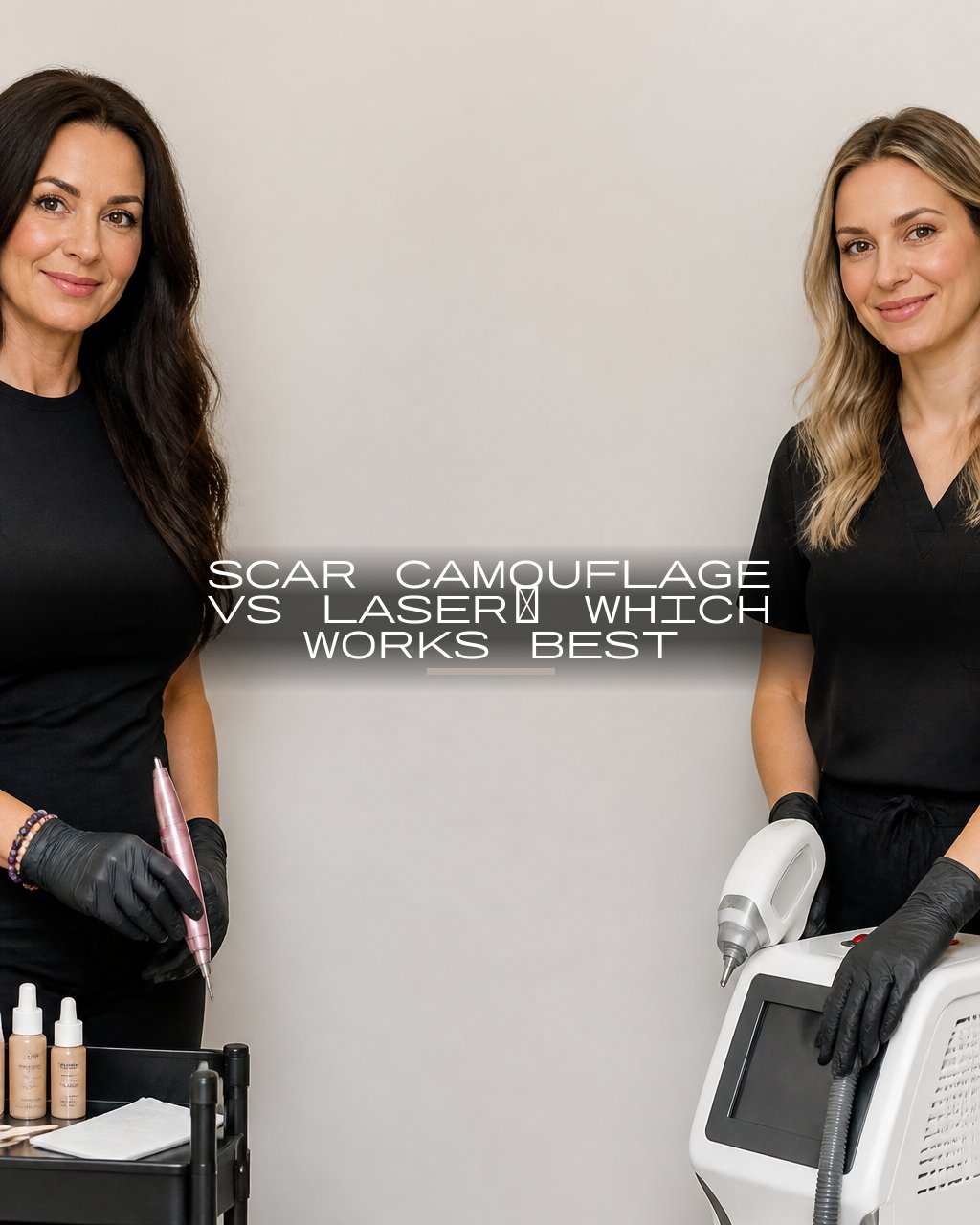
When considering scar camouflage vs laser treatment, it's important to understand that these approaches address scarring from fundamentally different angles, and choosing between them requires clarity on what each method actually does.
Scar camouflage uses specialized pigments to visually blend a scar with surrounding skin tone, reducing color contrast. Laser treatment works on the scar tissue itself, attempting to improve texture, flatten raised areas, or reduce discoloration through controlled thermal injury. One conceals; one treats.
Neither is universally better. The right choice depends on your scar type, skin tone, expectations, and timeline. Here's what separates them.
How Scar Camouflage Works
Scar camouflage deposits custom-matched pigment into the dermal layer of a mature scar to reduce color contrast. It works best on flat scars where texture is acceptable but color stands out, a pale surgical scar can become nearly invisible. The process is non-invasive with no thermal damage, making it suitable for sensitive skin.
How Laser Treatment Works
Laser treatment uses focused light energy to resurface scar tissue. CO2 lasers vaporize skin layers and stimulate collagen remodeling, flattening raised scars and improving texture. Fractional lasers treat portions of skin at a time for faster healing; full-ablation treats the entire surface but requires longer recovery. Laser addresses tissue structure that camouflage cannot, but carries higher risk of thermal damage, infection, and visible downtime.
Scars Suitable for Camouflage Tattooing
Scar camouflage works best on mature, stable scars (12-18 months post-injury) where color mismatch is the primary issue. Ideal candidates include flat surgical scars and pale scars where texture is already acceptable. Fresh scars are still remodeling and may change, making early camouflage risky.
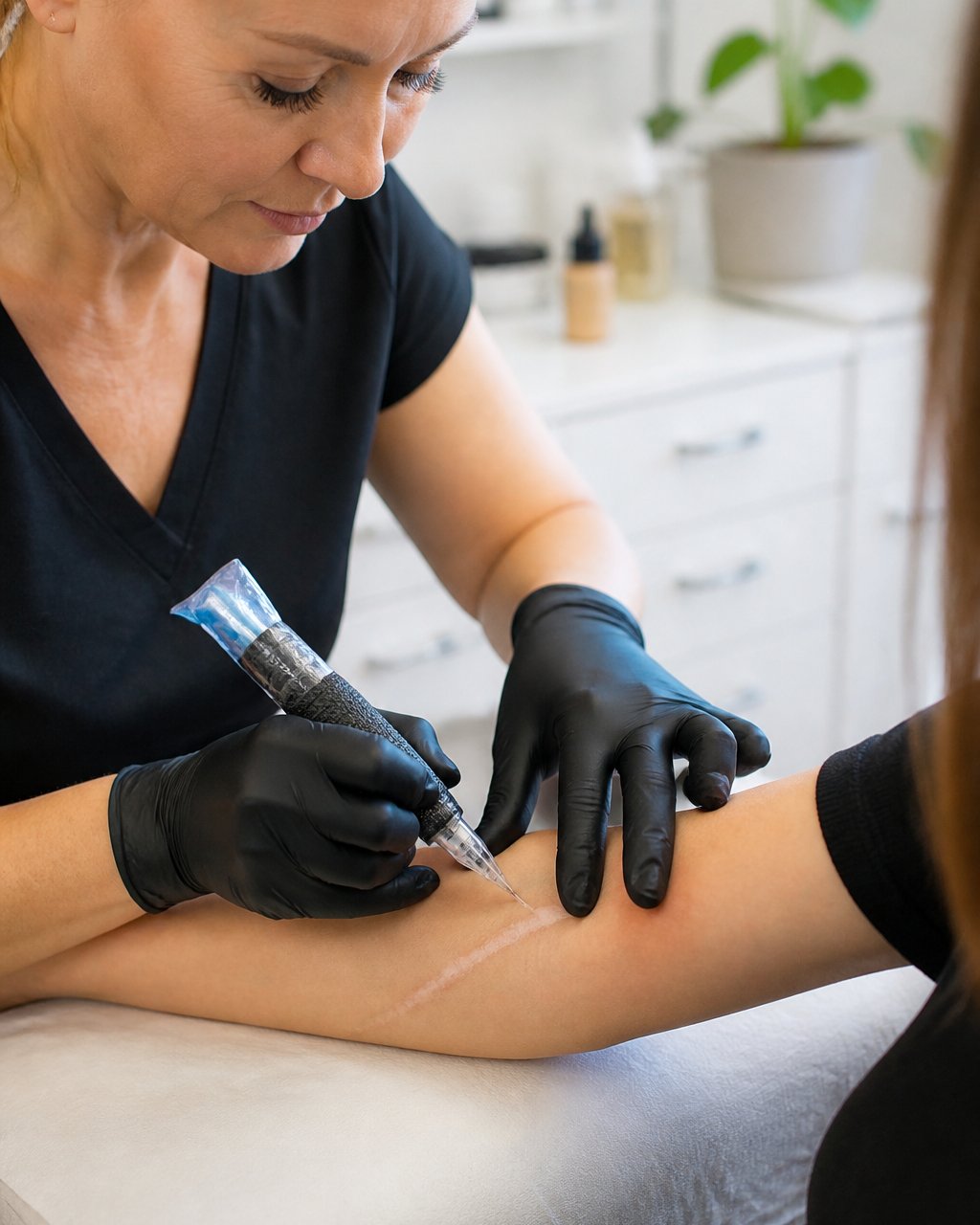
Hypertrophic and keloid scars are poor candidates for camouflage alone because raised texture remains visible. Atrophic, pitted scars respond poorly due to shadow from depression. Scars on high-movement areas like joints can experience faster pigment fading, though experienced technicians can minimize this with proper placement.
CO2 Laser Scar Treatment: When It Works Best
Fractional CO2 lasers treat portions of skin at a time, allowing faster healing than full-ablation. They work well for atrophic (pitted) scars by vaporizing damaged collagen and stimulating new formation.
Full-ablation CO2 lasers vaporize the entire surface in one pass for more aggressive collagen remodeling. More effective for severe pitting but carries higher infection risk and prolonged redness. Typically requires 1-2 sessions but demands 7-14 days of visible healing with oozing and crusting.
Vascular lasers (such as pulsed dye lasers) target hemoglobin to reduce redness in red or purple scars, including hypertrophic scars and early keloids. They work best on scars less than 1-2 years old. Multiple sessions (4-6) spaced 4-6 weeks apart are typical, with minimal downtime.
Pigment-targeting lasers (such as Q-switched Nd:YAG or alexandrite lasers) target melanin to lighten dark scars or reduce color irregularity. They are less effective on very dark skin tones and carry risk of post-inflammatory hypopigmentation. Require 2-4 sessions with minimal downtime.
Choosing the right laser depends on your scar's primary characteristic:
- Pitted or depressed scars: Fractional CO2 is the standard choice. Full-ablation if fractional has plateaued.
- Raised or hypertrophic scars: Vascular laser for red/purple appearance; fractional CO2 for texture flattening.
- Red or purple scars (early): Vascular laser as first-line; fractional CO2 if redness persists after vascular treatment.
- Dark or hyperpigmented scars: Pigment-targeting laser; requires experienced provider for skin of color.
- Mixed texture and color: Combination approach, often vascular laser first (to reduce redness), then fractional CO2 (to address texture).
Pain during laser treatment is moderate to high; numbing creams and local anesthesia are standard. Soreness persists for several days after fractional treatment and 1-2 weeks after full-ablation. Results are not immediate, collagen remodeling continues for 3-6 months after the final session.
How Long Does Scar Camouflage Last
Scar camouflage pigment typically lasts 3-5 years before fading noticeably, depending on skin type, sun exposure, and pigment formulation. Unlike traditional tattoos, camouflage pigments are lighter and skin-tone-specific, allowing precise matching but fading faster.
Sun exposure and pigment behavior: Direct sunlight accelerates fading significantly. Clients using SPF 30+ sunscreen see better longevity (5+ years), while regular sun exposure reduces it to 2-3 years. Sun exposure can also cause pigment darkening, particularly with iron oxide-based pigments.
Touch-ups and maintenance: Most clients return after 2-3 years for a refresh to restore color intensity and correct color shift. Touch-ups are routine and expected, meaning camouflage requires ongoing maintenance. Over a decade, multiple sessions accumulate in cost and time commitment.
Pigment removal and correction challenges: If dissatisfied with camouflage color, removal is difficult and imperfect. If you've had previous permanent cosmetic work that needs adjustment, Magnetic PMU Removal offers a specialized solution for correcting or removing prior pigmentation.
Pigment stability by skin type: Darker skin tones may experience different fading patterns than lighter skin. Some pigments fade more visibly on deeper skin as contrast changes; others are formulated specifically for deeper tones with better retention. Working with a technician experienced in color matching across diverse skin types is essential.
Treatment Timeline, Sessions, and Downtime
Scar camouflage typically requires 1-3 sessions spaced 4-8 weeks apart. The first session deposits the base color. Follow-up sessions refine the match and add depth. Total treatment spans 2-4 months from start to final result.
Downtime is minimal. Mild redness and slight swelling fade within 24-48 hours. You can return to normal activity immediately, though you should avoid water immersion and intense sweating for 48 hours. No visible scabbing or peeling in most cases.
CO2 laser treatment requires 3-5 sessions spaced 6-8 weeks apart for meaningful improvement. Fractional treatments are gentler and may need more sessions (5-8) but with less downtime per session.
Full-ablation CO2 produces 7-14 days of visible healing with oozing, crusting, and redness. Fractional CO2 shows improvement after 3-7 days of redness and mild peeling. Most clients can return to work after a week with makeup coverage, though sun protection is critical.
Pain differs too. Camouflage involves mild to moderate discomfort during application. Laser treatment is more painful during the procedure and causes significant soreness during healing.
Scar Camouflage Tattoo Cost and Long-Term Maintenance
Scar camouflage pricing depends on scar size, location, and complexity. A small surgical scar might cost less than a large burn scar requiring extensive color matching. Touch-ups are typically less expensive than the initial treatment.
Long-term costs accumulate because pigment fades. Budget for touch-ups every 2-3 years if you want consistent appearance. Over a decade, multiple sessions add up. However, camouflage requires no active maintenance between appointments, no special creams, no laser devices, no ongoing procedures.
Laser treatment also involves long-term costs. Each session carries the price of the procedure itself. Some scars require ongoing maintenance lasers to prevent regression. Combination treatments, laser followed by camouflage, can increase total cost but may produce superior results for mixed scar types.
For cost clarity, consult directly with your provider. Pricing varies significantly by location, provider experience, and scar complexity. Tonni Petty PMU Artistry offers personalized consultations to discuss your specific situation and provide accurate cost estimates.
Safety, Skin Tone, and Realistic Outcomes
Both treatments carry risks that vary by skin type. Laser treatment on darker skin tones can cause post-inflammatory hyperpigmentation or hypopigmentation, darkening or lightening of the treated area. Fractional lasers are safer than full-ablation for skin of color, but skill and experience matter enormously.
Scar camouflage also requires expertise with skin of color. Pigment selection is critical. A match that looks perfect on light skin may appear gray or muddy on deeper tones. An experienced technician with a strong portfolio of work on diverse skin types is essential.
Neither treatment removes scars completely. Both improve appearance. Camouflage makes scars less noticeable through color blending. Laser can improve texture and reduce visibility but cannot erase the scar entirely. Realistic expectations are crucial.
Complications are rare with experienced providers but possible. Laser can cause infection, persistent redness, or textural changes. Camouflage can result in pigment migration, color mismatch, or allergic reaction to pigment (uncommon but documented).
Contraindications matter. Active acne, recent sun exposure, certain medications, and keloid-prone skin affect suitability for laser. Pregnancy and certain skin conditions may affect camouflage candidacy. A thorough consultation identifies these factors before treatment.
Making Your Choice: A Decision Framework
Start with your scar's primary problem. Is it color mismatch, texture irregularity, or both?
Choose scar camouflage if:
- Your scar is flat but noticeably lighter or darker than surrounding skin
- You want minimal downtime and no visible healing
- Your scar is mature and stable (12+ months old)
- You prefer a non-invasive approach with quick results
- You're comfortable with touch-ups every 2-3 years
Choose laser treatment if:
- Your scar is raised, pitted, or has uneven texture
- You want structural improvement, not just color blending
- You can tolerate downtime and visible healing
- You're willing to commit to multiple sessions over months
- Your scar is acne-related, burn-related, or severely textured
Consider combination treatment if:
- Your scar has both color and texture problems
- You want maximum improvement across multiple dimensions
- You're willing to sequence treatments strategically
The decision ultimately depends on your scar characteristics, skin type, lifestyle, and expectations. An experienced technician can assess your specific situation and recommend the approach most likely to achieve your goals.
At Tonni Petty PMU Artistry, we specialize in scar camouflage with over 22 years of experience in permanent cosmetics. We've worked with diverse skin tones and complex scar types, and we understand the nuances of color matching and pigment stability. If you're considering camouflage, a personalized consultation can clarify whether this approach suits your scar and what realistic results look like for you.
Choosing between scar camouflage and laser treatment requires understanding what each actually accomplishes. Camouflage conceals; laser treats tissue. Neither is universally best, the right choice depends on your scar's characteristics and your priorities. If you're exploring scar camouflage, Tonni Petty PMU Artistry offers expert consultation and master-level technique with personalized color matching for your unique skin tone. Book an appointment to discuss your scar and learn whether camouflage can deliver the results you're seeking.
| Approach | Best For | Sessions Needed | Downtime | Longevity | Texture Improvement |
|---|---|---|---|---|---|
| Scar Camouflage | Flat scars with color mismatch | 1-3 | Minimal (24-48 hrs) | 3-5 years | None |
| CO2 Laser | Raised, pitted, or textured scars | 3-5 | Moderate (7-14 days) | Permanent tissue change | Significant |
| Combination | Mixed texture and color issues | 5-8 total | Moderate-high | Long-term | Significant |
American Institute of Intradermal Cosmetics standards for permanent cosmetics
Clinical evidence on fractional laser treatment for scars
Skin of color considerations in laser and pigment-based treatments
Frequently Asked Questions
Which scars are suitable for camouflage tattooing?
Stable, mature scars work best for scar camouflage. Your scar should be at least 12-18 months old, flat or slightly raised, and have settled in color and texture. Camouflage is most effective for scars with color contrast to surrounding skin, surgical scars, burn scars, and certain acne scars respond well. Raised, thick, or actively changing scars are poor candidates because the pigment won't blend properly. A consultation with a qualified technician can determine whether your scar meets these criteria.
Does scar camouflage last forever?
Scar camouflage typically lasts 3-5 years before fading or requiring touch-ups. The longevity depends on skin type, sun exposure, and how your body metabolizes the pigment. Unlike permanent makeup in other areas, scar camouflage pigment tends to fade more quickly because the scar tissue has different absorption and healing properties than surrounding skin. Touch-ups maintain color match and blending as the scar continues to mature and lighten naturally over time.
How does CO2 laser scar treatment differ from camouflage?
CO2 laser treatment works by resurfacing the scar tissue itself, the laser removes or remodels collagen to improve texture, depth, and contour. Camouflage tattooing, by contrast, leaves the scar tissue unchanged and instead applies skin-tone pigment to reduce color contrast and visual appearance. Laser is better for raised scars, textured scars, and depressed scars where tissue improvement is the goal. Camouflage works best for flat, stable scars where color blending is sufficient.
What is the typical cost for scar camouflage tattoo treatment?
Pricing for scar camouflage depends on scar size, location, color complexity, and the number of sessions required. Most providers charge per session rather than per scar. Costs vary widely based on the technician's experience and geographic location. For accurate pricing, consult directly with a qualified scar camouflage provider in your area. Many offer free or low-cost consultations to assess your scar and provide a treatment estimate.