 how-to
How Can You Tell If Scalp Micropigmentation Is Fading?
Last Updated: October 30, 2026
Quick Summary
Scalp micropigmentation fading shows up as an even, gradual softening of the hairline and loss of dot density, rather than isolated patches. Compare your scalp against photos of your healed result, taken under the same lighting and angles, every 8 to 12 weeks. Uneven or sudden changes point to migration, color shift, or application issues instead.
- Photograph the hairline, crown and side profile every 8 to 12 weeks under identical lighting.
- Even softening across the whole design over time usually indicates normal fading.
- Isolated blurred spots or sudden patches suggest migration or application problems instead.
- A hue shift toward warm, blue or green is a color shift, not fading.
- Sun exposure, harsh exfoliants and friction can all speed up fading.
Table of Contents
- What Scalp Micropigmentation Is and Why Pigment Softens Over Time
- How to Identify Scalp Micropigmentation Fading: A Self-Assessment Checklist
- SMP Fading Timeline: What Normal Changes Look Like From Year One to Year Five
- Fading Versus Pigment Migration, Color Shift and Poor Application
- Factors That Speed Up Fading and How to Prevent It
- Scalp Micropigmentation Touch-Up: When to Book and What to Ask
- Booking Your Scalp Micropigmentation Assessment and Keeping a Change Log
- Frequently Asked Questions
What Scalp Micropigmentation Is and Why Pigment Softens Over Time
Scalp micropigmentation (SMP) is a cosmetic tattooing method that places tiny dots of pigment into the upper layer of the scalp to mimic the look of a shaved head or fuller hair, and understanding scalp micropigmentation fading starts with knowing that the pigment is designed to soften gradually over time.
Scalp micropigmentation is a cosmetic procedure that deposits pigment in the skin to create the appearance of hair follicles.
Pigment does not stay exactly as it was on the first day. Skin constantly renews itself, and pigment can soften gradually over time. Knowing this helps you tell normal softening apart from a real problem.
How to Identify Scalp Micropigmentation Fading: A Self-Assessment Checklist
Most people notice SMP fading as a vague feeling that the result "looks different" before they can name what changed. A structured check removes the guesswork. The goal is to compare your scalp against a fixed baseline, your own healed result, under repeatable conditions, so you can tell gradual fading apart from a bad hair day, lighting, or a temporary healing phase.
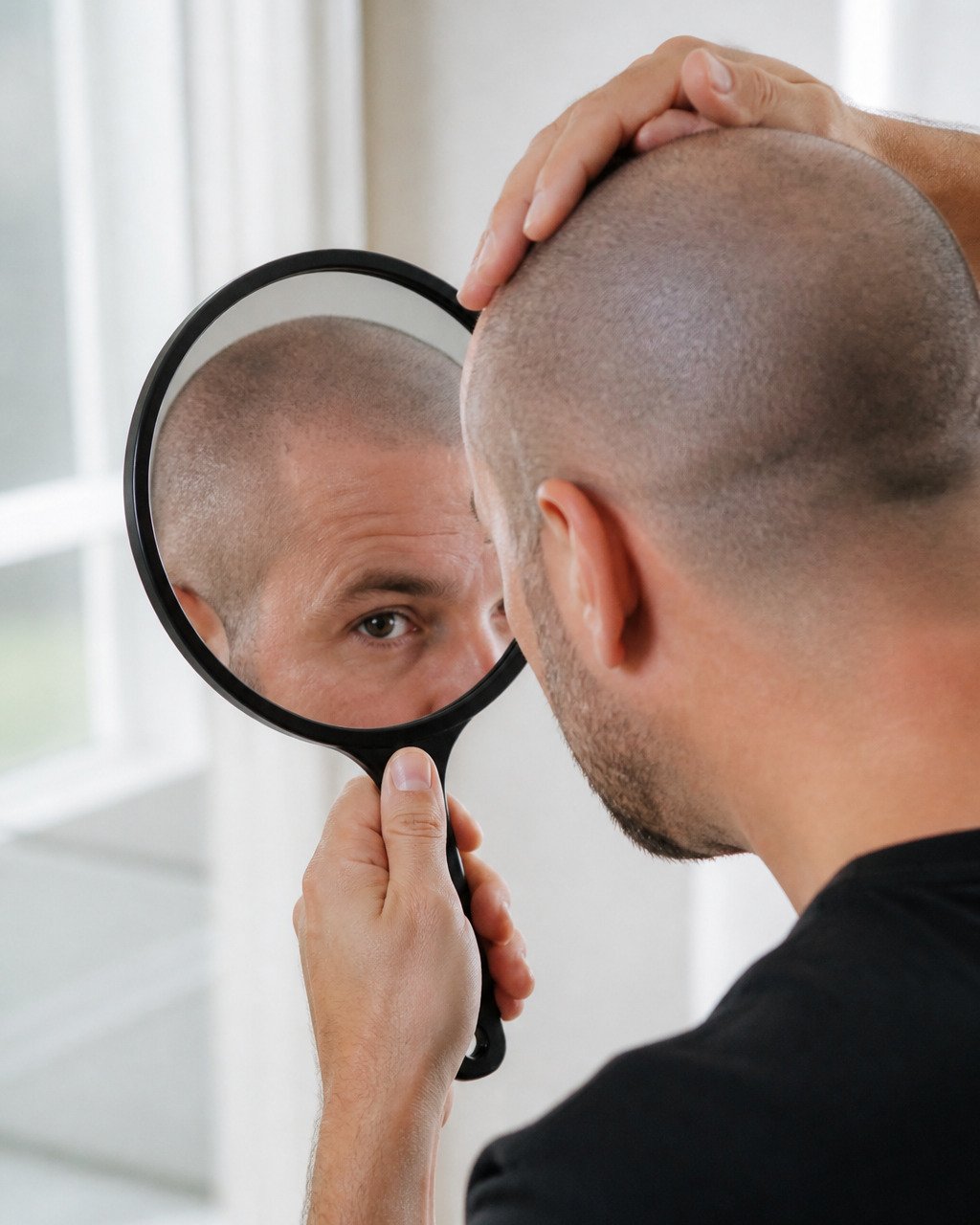
Set up a consistent viewing condition
Do the check the same way every time, or the comparison is meaningless:
- Lighting: Use bright, indirect daylight where possible. Avoid overhead bathroom lighting, which casts shadows that exaggerate patchiness.
- Angle: View the hairline straight-on, then at a 45-degree angle, then from above. Fading often shows first at the hairline edge when viewed at an angle.
- Distance: Stand about arm's length from a mirror. Close-up inspection under magnification reveals normal dot texture, not fading.
The five-point visual check
Work through these in order and note what you see:
- Hairline crispness. The front edge should read as a soft but defined boundary. Early fading shows as a slightly blurred or "smudged" edge rather than a sharp transition.
- Dot density. Compare the spacing between dots to your baseline photo. Fading reads as dots that look more spread out or lighter, not as dots that have moved.
- Uniformity across zones. Check the crown, mid-scalp, temples, and nape separately. Even fading affects zones proportionally; isolated light or dark patches point to something other than normal fading.
- Color tone. Hold a white sheet of paper next to the scalp as a reference. Fading looks like the pigment has lost saturation; a shift toward warm, blue, or green tones is a color-shift issue, not fading.
- Symmetry. Compare left and right. A result that fades evenly should change roughly equally on both sides.
Build a photo baseline you can trust
A photo log only works if the frames are comparable:
- Take the first set once healing is complete and the result has settled, typically several weeks after your final session, not during the first weeks when pigment is still surfacing.
- Use the same room, the same light, and the same phone or camera each time.
- Include one frame with a coin or ruler near the hairline for scale if you want to judge edge definition precisely.
What not to judge yet
Do not assess fading during the first few weeks after a session. Freshly healed pigment can look different from the settled result. Wait until the result has stabilized before you start comparing frames.
A quick scoring method
Rate each of the five points from 1 (unchanged from baseline) to 3 (clearly changed), then total:
- 5-7: Within normal variation; keep monitoring.
- 8-11: Noticeable softening; start planning a professional assessment.
- 12-15: Clear change; book an assessment to confirm the cause before assuming a touch-up is the answer.
The score is a conversation starter, not a diagnosis. Its value is that it forces you to compare like with like instead of reacting to a single glance in bad light.
SMP Fading Timeline: What Normal Changes Look Like From Year One to Year Five
Normal fading is gradual. The exact pace depends on skin type, sun exposure, scalp care and how the pigment was placed.
- Year one: The result usually settles. Edges may look a bit softer than right after healing.
- Years two to three: Density often looks lighter. Many clients start to consider a touch-up.
- Years four to five: Definition can noticeably decline, especially along the hairline.
These are general patterns, not guarantees. Your results will depend on your own skin and care routine.
Fading Versus Pigment Migration, Color Shift and Poor Application
Not every change in appearance is fading, and treating the wrong problem wastes a touch-up. The four issues below can look similar at a glance but differ in pattern, timing, and cause. Matching what you see to the right pattern is the step that determines whether a refresh, a correction, or a different approach is appropriate.
Fading
- What it looks like: An even, gradual loss of saturation and definition across the whole design. The hairline softens uniformly, dots look lighter but stay in place, and the change tracks with time since your last session.
- Why it happens: The body gradually breaks down a small amount of pigment as skin renews, and sun exposure and product use accelerate the process.
- Pattern to expect: Proportional change across zones, with the hairline edge usually showing first because it is the most visually sensitive area.
Pigment migration
- What it looks like: Dots that appear blurred, larger, or spread beyond their original position, often creating a smudged or haloed edge. It can look like the design has "bled."
- Why it happens: Pigment placed too superficially or in skin that holds it loosely can drift during healing or over time; friction and aggressive product use can contribute.
- Pattern to expect: Isolated or asymmetric areas rather than an even change, frequently at the hairline or temples.
Color shift
- What it looks like: The tone moves away from the original neutral or cool black-brown toward warm, blue, green, or gray. It is a hue change, not just a lightness change.
- Why it happens: Pigment formulation, depth of placement, sun exposure, and individual skin chemistry all influence how a pigment ages. Some pigments are more prone to shifting than others.
- Pattern to expect: A cast that develops over months to years and may be more visible in certain light; it can coexist with fading.
Poor application
- What it looks like: Uneven density, visible patches, dots that are too large or too sparse, or a hairline that never looked natural, present from the start rather than developing later.
- Why it happens: Inconsistent depth, uneven dot placement, or a design that did not account for the client's pattern and skin.
- Pattern to expect: A problem that is visible once healing completes and does not improve with time; it may worsen as surrounding pigment fades and the unevenness becomes more obvious.
How to tell them apart
| What you observe | Most likely issue |
|---|---|
| Even softening across the whole design over time | Fading |
| Blurred or enlarged dots in isolated areas | Pigment migration |
| Hue change toward warm, blue, or green | Color shift |
| Unevenness present from the start | Poor application |
| A single patch that looks different from the rest | Migration, color shift, or application issue, get it assessed |
Why the distinction matters before you book
A touch-up adds pigment to soften fading. It is not a fix for migration, color shift, or an uneven original design, and adding pigment over a shifted or migrated area can make the problem more visible. That is why a professional assessment should identify the pattern first and recommend a correction plan second. If you are unsure which pattern you are seeing, document it with the photo method above and bring those frames to your consultation.
Factors That Speed Up Fading and How to Prevent It
Several habits can make SMP soften faster. Common factors include:
- Heavy, long-term sun exposure without protection
- Harsh exfoliants or scalp products that irritate the skin
- Frequent sweating and friction from hats or helmets
Simple prevention steps can help:
- Wear a hat or use a broad-spectrum sunscreen when outdoors
- Use gentle products on the scalp
- Avoid picking or scratching the treated area
Scalp Micropigmentation Touch-Up: When to Book and What to Ask
A touch-up refreshes pigment that has softened. Many clients book one when the hairline looks less defined or density seems lighter than their original result. Before booking, you can review what recovery and aftercare involve.
Before you book, ask:
- How long after my last session should I wait?
- What does the touch-up process involve?
- How will you match my existing design?
Pricing depends on the scope of work and your existing design, so contact Tonni Petty PMU Artistry directly for current pricing or a quote.
Booking Your Scalp Micropigmentation Assessment and Keeping a Change Log
If you suspect fading, an in-person assessment is the most reliable way to know what is happening. You can explore custom scalp micropigmentation for fuller-looking hair and scar camouflage and book a consult. A consultation lets a technician check the design, compare it with your photos and recommend whether a touch-up makes sense.
Keep a simple change log to help with that conversation:
- Date of each photo
- Lighting and angle used
- Notes on any changes you notice in edges, density or color
- Questions to bring to your appointment
When you are ready to act, you can contact Tonni Petty PMU Artistry in Olympia, WA, to book an assessment.
Frequently Asked Questions
Does scalp micropigmentation fade over time?
Yes, scalp micropigmentation fades gradually as the skin renews and pigment particles slowly break down. Most people notice softer hairline edges and slightly lighter density within a few years, though the rate varies with skin type, sun exposure and aftercare. Fading is usually even and gradual. Patchy or uneven areas are more often a sign of application or healing issues, so an in-person assessment helps determine the cause.
How often does scalp micropigmentation need a touch-up?
Many clients book a touch-up or refresh every few years, once the hairline looks less defined or the density no longer matches their goals. The timing depends on how the pigment has held, how much sun exposure the scalp gets and how the first sessions healed. A consultation can show whether a refresh will restore definition or whether the area needs a different approach. Pricing for touch-ups depends on the scope of work, so contact Tonni Petty PMU Artistry directly for a current quote.
Can sun exposure make scalp micropigmentation fade faster?
Yes, prolonged UV exposure can speed up pigment breakdown and cause color to look lighter or cooler over time. Wearing a hat, using a sunscreen formulated for the scalp and avoiding long periods in direct sun help preserve the pigment. Consistent aftercare also supports even healing and helps the treatment hold its shape longer, which makes changes easier to spot if they do occur.
How can you tell fading from a change in scalp or hair color?
Fading usually shows as softer edges and a gradual reduction in definition across the treated area, while a color change from hair dye, graying or scalp tone shifts tends to affect the entire scalp evenly. Take photos in the same lighting every few months to compare. If you are unsure, a professional can examine the pigment and tell you whether the change is fading, color shift or an application issue.