 how-to
Managing Expectations for Brow Symmetry: A 2026 Guide
Table of Contents
- Why Eyebrows Are Not Symmetrical: Understanding Facial Anatomy
- The Professional Brow Mapping Process: A Step-by-Step Guide
- How to Fix Asymmetrical Eyebrows: Realistic Strategies for Balance
- Managing Expectations for Brow Symmetry: The 'Sisters, Not Twins' Rule
- Communicating Your Symmetry Goals to Your PMU Artist
- Post-Procedure Maintenance and Long-Term Symmetry
- Conclusion: Embracing Facial Balance Over Perfect Symmetry
- Frequently Asked Questions
Last Updated: September 12, 2026
Why Eyebrows Are Not Symmetrical: Understanding Facial Anatomy
No face is perfectly symmetrical, that is anatomy, not a flaw. At Tonni Petty PMU Artistry, with more than 22 years of brow work, managing expectations for brow symmetry starts with understanding why asymmetry exists.
Facial asymmetry is the natural variation in bone structure, muscle movement, and skin tension between the left and right sides of the face. It affects every feature: eyes sit at different heights, the jaw shifts to one side, and brow bones develop differently long before you touch a tweezer.
The Role of Bone Structure and Muscle Movement
Brow position is decided by the frontal bone and the muscles that move it. One brow bone often sits higher or protrudes further, and the corrugator and frontalis muscles rarely pull with equal force. Raise one eyebrow more often than the other and that muscle strengthens, lifting the brow over time.
An artist who maps brows by measuring from the nose alone will always fight the face. The bone is the foundation; ignore it and the result looks off no matter how clean the strokes are.
How Aging and Brow Migration Affect Symmetry
Brows migrate downward and outward with age as skin loses elasticity and the brow fat pad descends. One side usually descends faster, clients with even brows in their twenties often notice a difference by their forties.
Hormonal changes, thyroid conditions, and hair loss from medical treatment can thin one brow more than the other. This is structural, not a shaping problem, and it changes what a realistic outcome looks like.
The Professional Brow Mapping Process: A Step-by-Step Guide
Professional brow mapping establishes where each brow should start, arch, and end based on your facial proportions, not a template. A skilled artist maps both brows independently, then compares them rather than forcing one to mirror the other, the goal is a design that reads as balanced from a normal viewing distance, not two identical sets of numbers.
Total time: 20-30 minutes Difficulty: Professional (performed by a trained technician)
Tools and Measurements Used in Brow Mapping
- Brow mapping string or thread: establishes the center line and vertical alignment
- Calipers: measures the distance between the brow head and the inner eye corner
- Brow pencil or marking paste: plots guide points before pigment is applied
- Stencils: a rough reference only, never a final guide
- Brow compass or flexible ruler: checks vertical brow-to-eye distance and horizontal distance between brow heads
The Landmarks Every Artist Measures
Mapping is built on fixed reference points, located on both sides of the face before a line is drawn:
- The midline: a vertical line dropped from the center of the forehead through the philtrum, the anchor for every other measurement.
- The brow head (start): typically aligned with the inner corner of the eye, adjusted for nasal bridge width. A wider bridge pushes it outward; a narrow bridge pulls it inward.
- The arch peak: where the brow bone sits highest, usually the outer two-thirds of the brow, above the outer edge of the iris rather than the pupil.
- The tail (end): found by drawing a diagonal line from the outer corner of the nose through the outer corner of the eye. It should not drop below the brow head, or the eye looks tired.
- The brow-to-eye distance: the vertical gap between brow and eyelid, often the most visible asymmetry and the one clients notice first.
Step-by-Step Mapping
- Measure the center of the face and mark the vertical line.
- Locate the brow head using the inner corner of the eye as a reference, then adjust for nasal bridge width.
- Mark the arch peak based on where the brow bone sits highest, not where a template places it.
- Determine the tail using the outer corner of the nose and eye.
- Measure both brows separately and record the difference in millimeters at the head, arch, and tail.
- Adjust the design so the brows read as balanced, not identical.
The last step is where most artists go wrong. Forcing brows to match numerically pushes one out of alignment with the bone, looking worse than the original asymmetry. A common pattern is a 2-4 mm arch height difference, invisible in a mirror, but large enough to matter when forced.
Reading the Measurements Without Over-Correcting
Once the numbers are on the face, the artist decides which differences to work with and which to leave alone:
- Differences under about 2 mm are usually left as-is. The eye reads them as natural.
- Differences of 3-5 mm are addressed through density and arch placement, not by moving the brow head or tail.
- Differences over 5 mm may need a conversation about whether the goal is camouflage or correction, and whether a single session can achieve it.
The artist also checks the design against the client's expressions: a brow balanced at rest can look uneven when the client unconsciously raises one eyebrow. Photographing the design from the front, at an angle, and in natural light before pigment is applied catches problems a mirror will not.
How to Fix Asymmetrical Eyebrows: Realistic Strategies for Balance
Asymmetrical eyebrows are corrected by building balance, not erasing the difference. A common mistake is over-correcting the smaller or lower brow until it sits too high or too thick. The goal is visual balance across the whole face, not a mirror image.
Strategies that work in practice:
- Build up the weaker brow with additional pigment density rather than reshaping the stronger one.
- Adjust the arch height on the lower brow to lift the eye area subtly.
- Leave the stronger brow mostly alone. It is your reference point.
- Use a combination technique (hair strokes plus soft shading) when one brow has thinner hair density.
When to Use Microblading vs. Powder Brows for Correction
Microblading suits normal to dry skin with existing hair and a desire for crisp strokes. Powder brows work better for oily or mature skin and brows with significant gaps, because soft shading holds shape more reliably than fine strokes. Many correction cases do best with a combo: strokes at the front, shading through the body and tail.
If you are coming from a previous procedure that healed unevenly or shifted color, correction may require lightening the old pigment first. Tonni Petty PMU Artistry offers magnetic PMU removal for exactly this situation, followed by a fresh design once the skin has settled.
Managing Expectations for Brow Symmetry: The 'Sisters, Not Twins' Rule
The "sisters, not twins" rule means your brows should look related and balanced, not identical. It is the most useful framework for managing expectations for brow symmetry, and the conversation we have with every client before we begin.
The honest version: perfect symmetry is a myth. No amount of skill, pigment, or measurement makes two brows identical, because the face underneath is not identical on both sides. A skilled artist delivers a pair that frames the face evenly and moves naturally with your expressions.
Why the Mirror Lies to You
Most clients convinced their brows are badly uneven are reacting to a perceptual effect: a mirror shows a reversed image of a face you have studied your whole life, and the reversal exaggerates small differences. A 2 mm arch difference no one else notices can look like a canyon from six inches away.
There is also a tendency to fixate on one feature in isolation. Stare at your brows long enough and your brain stops reading them as part of a face and starts reading two separate shapes that should match. That is not how anyone else sees you, friends, coworkers, and photographers read the whole face at once, and the whole face is what the artist designs for.
The Psychological Side Most Articles Skip
A smaller group of clients experience something closer to brow dysmorphia, a persistent, distressing preoccupation with a perceived flaw that does not match what others see. This is not vanity, and better mapping cannot fix it. It is a body-image pattern that tends to intensify after a procedure, because the client now has a permanent result to scrutinize.
Signs worth recognizing before booking:
- The client has had multiple corrective procedures on the same brows and is still dissatisfied.
- The client brings dozens of reference photos and cannot describe what "balanced" would look like.
- The client describes the asymmetry in catastrophic terms ("ruined," "unfixable") that do not match the visible difference.
- The client asks the artist to promise an exact outcome in advance.
When these patterns show up, the responsible move is to slow down, recommend a consultation without a procedure, and sometimes suggest the client speak with a mental health professional first. A good artist would rather lose a booking than create a result the client will never feel good about.
Scripts for the Consultation Conversation
Expectation management is mostly language. Framings that work:
- Name the asymmetry out loud. "I can see that your left brow sits about 3 mm lower than your right. Here is how I plan to work with that." Clients relax when they feel seen rather than corrected.
- Reframe the goal. "We are not trying to make these identical. We are trying to make them balance each other so your face looks even."
- Show, don't promise. Use the mapped design and a photo to show what balanced will look like, rather than describing it in words.
- Set the healed expectation early. Pigment fades and settles over four to six weeks. The brow you see on day one is not the brow you will have at week six.
- Give the client a role. Ask them to look at the design in a mirror, then in a phone selfie, then from across the room.
When to Refer Out
Not every client is a good candidate for a symmetry-focused procedure. If their distress is out of proportion to the visible asymmetry, if they have a history of repeated corrective work with no satisfaction, or if the brows cause significant daily anxiety, the ethical move is to refer them to a mental health professional rather than book the procedure. Recognizing this small part of the client base protects both client and artist.
Communicating Your Symmetry Goals to Your PMU Artist
Bring reference photos, but the right ones. Brows on a different face shape will set you up for disappointment. Show examples of the density, arch style, and color you like, and let the artist map the shape to your bone structure.
Ask these questions at your consultation:
- What asymmetry do you see in my brows, and how will you work with it?
- Which technique suits my skin type and hair density?
- What will the healed result look like in 12 months?
- How many sessions will this take, and how long between them?
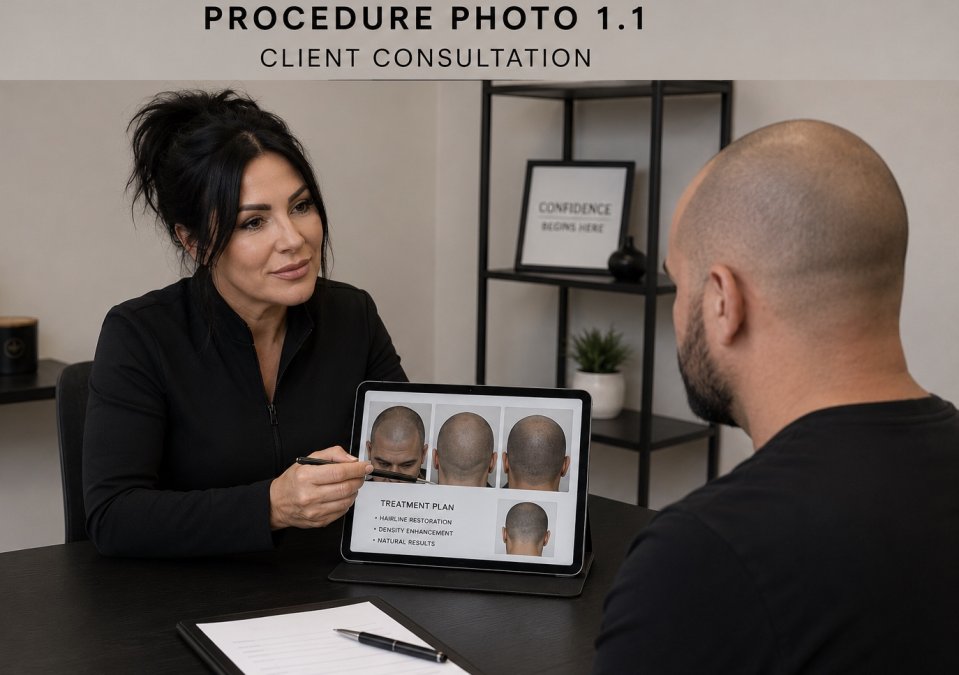
A thorough consultation should include a full facial assessment, not just a brow measurement. At Tonni Petty PMU Artistry, every appointment starts with a personalized consultation, and our master-level training means we map to your features rather than applying a standard shape.
Post-Procedure Maintenance and Long-Term Symmetry
Brows change after the procedure, and knowing the timeline prevents panic. In the first two weeks, pigment darkens, then flakes, then appears lighter. Color settles by week four, and a touch-up at the six-to-eight week mark refines shape and density.
Long-term symmetry depends on a few habits:
- Sun protection: UV exposure fades pigment unevenly, and one brow often gets more sun than the other.
- Avoid harsh exfoliants over the brow area, which speed up fading.
- Book touch-ups when you notice fading, not after the shape has drifted.
- Track your brows with photos in the same lighting every few months.
Aging continues after your procedure, so expect minor drift over the years. Periodic refreshes keep both brows balanced as the face changes.
Conclusion: Embracing Facial Balance Over Perfect Symmetry
Chasing identical brows sets you up for disappointment, because the face you were born with was never symmetrical. The better goal is balance: brows that frame your features evenly, move naturally, and hold their shape over time.
That is the standard we hold at Tonni Petty PMU Artistry. With over 22 years in permanent cosmetics, Master Technician certification through the American Institute of Intradermal Cosmetics, and membership in the American Academy of Micropigmentation, we design every brow to your bone structure and skin type, not a template. Whether you need microblading brows, powder brows, or correction of previous work, our personalized consultation starts with what your face actually needs.
Book an appointment with Tonni Petty PMU Artistry and get brows designed for your face, not someone else's.
Frequently Asked Questions
Should your eyebrows be perfectly symmetrical?
No, perfectly symmetrical eyebrows are a myth. Human faces are naturally asymmetrical due to bone structure, muscle movement, and natural brow growth patterns. The goal of professional brow artistry is visual balance, not mathematical perfection. A skilled artist uses brow mapping to create harmony between your features, ensuring your brows look like sisters, not identical twins. This approach yields natural-looking results that enhance your unique facial anatomy.
How does bone structure affect eyebrow symmetry?
Bone structure dictates the foundation of your brow placement. The brow bone, eye socket depth, and forehead shape vary from side to side, causing one brow to sit naturally higher or lower. Muscle movement from habitual expressions like raising one eyebrow can also deepen these differences over time. A professional brow mapping process accounts for these skeletal and muscular factors, designing a shape that works with your anatomy rather than forcing an unnatural symmetry.
Can brow mapping fix significant facial asymmetry?
Brow mapping can significantly improve the appearance of facial asymmetry by using precise measurements to create visual balance. However, it cannot change your underlying bone structure. For clients with notable asymmetry, a PMU artist might use techniques like microblading or powder brows to add hair strokes or shading in specific areas, drawing the eye away from imbalances. The goal is to manage expectations by enhancing your natural features, not creating a perfectly mirrored face.
What should I expect during a professional brow mapping session?
During a professional brow mapping session, your artist will assess your facial proportions using tools like calipers and a brow mapping string. They will measure the brow head, arch, and tail to determine the ideal shape for your face. You will discuss your goals and lifestyle to ensure the design fits your needs. This process is collaborative, allowing you to see the proposed shape before any pigment is applied, ensuring you are confident in the final result.