
 how-to
How to Fix Orange Faded Eyebrows: PMU Correction Guide
Table of Contents
- Why Do Eyebrow Tattoos Turn Orange?
- Color Theory: Neutralizing Brassiness in Orange Faded Eyebrows
- PMU Color Correction Techniques for Orange Brows
- Emergency PMU Removal: When Correction Isn't Enough
- Makeup Camouflage and Post-Correction Aftercare
- Common Mistakes to Avoid When Fixing Orange Faded Eyebrows
- Frequently Asked Questions
Last Updated: September 11, 2026
Why Do Eyebrow Tattoos Turn Orange?
If your once-crisp microblading has faded into a rusty, orange hue, you're not alone. The short answer: pigment oxidation, iron oxides in warm-toned brow pigments break down over time and shift toward orange as your skin metabolizes them.
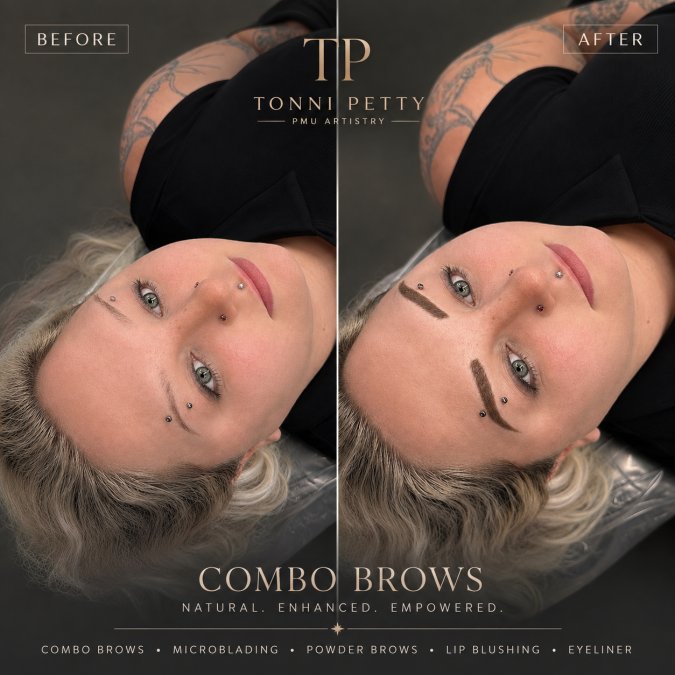
This guide from Tonni Petty PMU Artistry breaks down how to fix orange faded eyebrows, from professional PMU color correction techniques to at-home camouflage while you wait for your appointment.
Many guides say to "just add more pigment" without addressing why the shift happened, which almost always makes it worse.
Pigment Oxidation and the Dermal Layer
Pigment oxidation occurs when iron oxide particles in brow pigment are exposed to the skin's natural processes over time. Your immune system breaks down foreign particles in the dermal layer, and as pigment molecules shrink, they reflect light differently. Black and brown pigments contain a mix of colors; when cooler tones fade first, warm orange undertones remain.
Pigment must be deposited in the dermal layer, below the epidermis, for semi-permanent makeup to last. The deeper it sits, the longer it stays, but the more prone it is to gradual oxidation. That's why a fresh brow tattoo looks rich and cool-toned, while a two-year-old one often looks warm and brassy.
Warm Undertones and Ash-Based Pigments
Clients with warm skin undertones are more likely to experience this shift because their complexion amplifies warm pigment tones. Ash-based pigments with cooler, grey-leaning modifiers stay balanced longer; warm-based or iron oxide-heavy formulas shift orange faster.
A patch test before any corrective session is essential: it tells your technician how your skin will react to the new pigment and whether a neutralizing formula will hold. Skipping it is one of the most common mistakes in brow correction.
Color Theory: Neutralizing Brassiness in Orange Faded Eyebrows
Fixing orange faded eyebrows starts with the color wheel, not a heavier pigment load. Orange sits opposite blue, so blue and cool green neutralize it. A skilled technician mixes a small amount of cool modifier into the corrective pigment to counteract brassiness without turning the brow grey or muddy.
Adding warm brown pigment over an orange brow deepens the orange rather than fixing it. Correction must come from the opposite side of the color wheel.
Complementary Colors and the Color Wheel
The color wheel is the technician's most important neutralization tool:
- Orange is neutralized by blue, which is directly opposite
- Red-orange is neutralized by blue-green
- Yellow-orange is neutralized by blue-violet
- Brassy warm brown is neutralized by a cool taupe with ash modifiers
For brow correction, most technicians reach for a cool-toned taupe or a formulated neutralizer. The goal isn't to erase the orange in one session, but to gradually shift toward a natural, cool-neutral brown over multiple appointments.
Why the Pigment Chemistry Changes the Neutralizer You Need
Not all orange is the same orange, and the neutralizer that works on one brow can fail on another. The difference comes down to what the original pigment was built from.
Iron oxide pigments are mineral-based, the traditional workhorse of permanent makeup because they're stable, predictable, and hold well in the dermal layer. But iron oxides are highly reactive to ultraviolet light. Over months and years of sun exposure, the particles oxidize and shift warm: the cooler black and cool-brown components fade first, leaving warm rust tones behind. This is the classic orange brow. Because the shift is a chemical change in the pigment itself, the orange is usually even across the brow and responds well to a blue-based or blue-green neutralizer.
Organic (carbon-based) pigments fade by dispersing rather than oxidizing, and when they shift they often go pink, red, or salmon rather than true orange. A pink-shifted organic brow needs a green or yellow-green modifier rather than a straight blue, blue can push it grey or muddy.
This is why a patch test and pigment history matter. If a technician can identify what was originally used, or read the undertone of the current color, they can pick the right side of the color wheel instead of guessing.
Sun Exposure, Skin Undertones, and Retention
Two other variables change neutralizer performance:
- UV exposure. Brows that see regular sun fade faster and shift warmer sooner. Daily SPF on the brow area once healed is one of the few things a client can do to slow the next oxidation cycle.
- Skin undertones. Warm and olive undertones amplify orange pigment, so a warm-complexioned client may need a stronger cool modifier than a cool-complexioned client showing the same orange.
- Retention. Oily skin fades faster and less evenly, so correction may need to be layered more gradually.
PMU Color Correction Techniques for Orange Brows
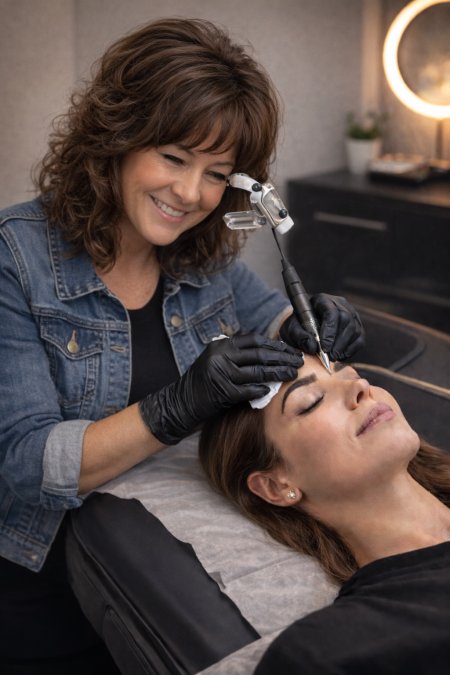
PMU color correction techniques vary based on how saturated the orange is, how deep the pigment sits, and how much the skin has healed. A light, faded orange responds well to a single corrective session with a cool-toned formula; a saturated, migrated orange may need removal first.
The most reliable approach is two-step: neutralize the warmth with a cool modifier, then rebuild shape and density with a taupe or ash-based pigment in a follow-up session. Doing both in one sitting often leads to over-saturation and a muddy result.
Cool-Toned Pigments and Taupe Formulations
Cool-toned pigments and taupe formulations are the workhorses of brow correction. Taupe is a grey-brown between warm and cool, making it an excellent bridge color for neutralizing orange without going ashy. A skilled artist adjusts the ratio of cool modifier to taupe based on skin undertones and the intensity of the existing orange.
Pigment retention matters as much as pigment choice. If the skin is compromised or the previous pigment has migrated, the new pigment may not hold evenly.
Layering and Touch-Up Timing
Layering means building color gradually across multiple sessions rather than chasing the final result in one appointment:
| Session | Timing | Purpose |
|---|---|---|
| Correction 1 | Day 0 | Neutralize orange, establish base |
| Healing check | Week 4-6 | Assess retention and color shift |
| Correction 2 | Week 6-8 | Refine shape, adjust tone |
| Touch-up | Month 3-4 | Final balance and density |
Waiting periods before corrective treatment are non-negotiable. The skin must fully heal before a technician can accurately judge healed results, rushing this timeline is one of the most common mistakes.
Emergency PMU Removal: When Correction Isn't Enough
Emergency PMU removal is the right call when existing pigment is too saturated, has migrated outside the brow shape, or has shifted to a color that can't be safely neutralized in one corrective session. Removing some or all of the pigment first gives the technician a clean canvas.
The two main options are saline removal and laser tattoo removal. Each has trade-offs in cost, comfort, and suitability for different pigment colors.
Saline Removal vs. Laser Tattoo Removal
Saline removal uses a hypertonic saline solution to draw pigment up through the skin. It's gentler on surrounding tissue and works well on warm-toned or recently applied pigment, but usually needs multiple sessions spaced several weeks apart.
Laser tattoo removal breaks pigment particles apart with light energy. It's often faster for dark, saturated pigment, but less effective on warm orange tones because orange pigment doesn't absorb laser wavelengths as efficiently. A trained technician can advise which method suits a client's situation.
For clients in the Olympia area, Tonni Petty PMU Artistry offers professional pigment removal and correction services, including Magnetic PMU Removal, with a personalized consultation to determine whether removal, correction, or a combination is the right path.
Makeup Camouflage and Post-Correction Aftercare
Makeup camouflage bridges the gap until your correction appointment, and post-correction aftercare determines whether the new pigment holds. The wrong product or habit can undo months of work.
Makeup Camouflage While You Wait
A peach or orange color-correcting concealer won't help, you need the opposite. A green or blue-based corrector applied thinly under your brow pencil neutralizes the orange before you draw the shape. The key is thin layers: a heavy hand leaves a grey or ashy cast harder to hide than the original orange.
A practical routine for camouflaging orange brows:
- Prime and mattify. Orange shows through more on shiny skin. A light mattifying primer keeps the corrector from sliding.
- Apply a thin layer of green or blue corrector only over the orange areas, not the whole brow.
- Tap, don't sweep. Use a small dense brush or your fingertip to press the corrector into the skin.
- Layer a cool-toned brow pencil or powder over the top to rebuild the shape and color.
- Set with a translucent powder to lock the correction in place.
If your brows are very warm, a blue-based corrector often works better than green. If they lean red-orange, green is usually the better choice. Test both on a small area first.
Post-Correction Aftercare: How It Differs from Initial Microblading
Corrective tattooing isn't the same as a first microblading session, and aftercare reflects that. The skin has already been through at least one healing cycle, sometimes saline or laser removal too, so tissue is more compromised, retention is less predictable, and healing can run longer.
A typical corrective-tattoo healing timeline:
- Days 1-3: The brow looks darker and warmer than the final result. Some redness and mild swelling is normal. Keep the area dry except for the aftercare ointment your technician recommends.
- Days 4-7: Light flaking begins. Do not pick or scratch, picking pulls pigment and can leave patchy, uneven results.
- Weeks 2-3: The brow may look like it has faded significantly, this is the "ghost phase" and is normal. The color is still settling in the dermal layer.
- Weeks 4-6: True color emerges. This is the earliest point at which a technician can accurately judge retention and decide whether a second correction session is needed.
- Weeks 6-8: Second correction session, if required, to refine tone and density.
Aftercare rules for the first two weeks:
- Keep the area dry and avoid heavy sweating
- Do not pick or scratch the healing skin
- Apply the aftercare ointment your technician recommends
- Avoid direct sun exposure and always use SPF once healed
Avoid oil cleansing and exfoliation on the brow area for at least four weeks after any corrective session, these strip pigment faster and trigger uneven fading. Because corrective skin is already compromised, this window matters more than after a first microblading session; rushing back into actives or exfoliants is a common reason a correction fades unevenly.
Common Mistakes to Avoid When Fixing Orange Faded Eyebrows
Correction work requires deeper knowledge of color theory, pigment chemistry, and skin healing than a standard microblading appointment, an inexperienced artist can turn an orange brow grey, muddy, or darker than before.
Other mistakes to avoid:
- Booking a correction before the previous pigment has fully healed
- Skipping the patch test
- Choosing a warm-based pigment to "cover" the orange
- Expecting a single session to fully correct years of oxidation
- Neglecting aftercare and sun protection
At Tonni Petty PMU Artistry, every correction starts with a personalized consultation and a patch test. With over 22 years of experience and Master Technician certification through the American Institute of Intradermal Cosmetics, we correct the color shift at its source rather than mask it, whether that means rebuilding tone with Powder Brows or another corrective technique.
Orange faded eyebrows are frustrating, but fixable with the right technique and technician. Tonni Petty PMU Artistry offers expert PMU color correction techniques, professional pigment removal, and personalized aftercare for clients across Washington State. With Master Technician certification, membership in the American Academy of Micropigmentation, and over 22 years of experience, we correct the color shift at its source. Book your consultation with Tonni Petty PMU Artistry and get brows that look natural and balanced.
Frequently Asked Questions
How to get orange tint out of eyebrows?
Orange tint from semi-permanent makeup can be removed through professional PMU color correction, saline removal, or laser tattoo removal. Color correction uses cool-toned pigments to neutralize the orange, while saline and laser options lift the existing pigment from the dermal layer. A brow technician will assess your skin undertones and pigment retention to recommend the safest method. At-home remedies like exfoliation or oil cleansing may soften the surface but cannot remove pigment that has settled deeper.
Can color correction fix orange faded eyebrows?
Yes, PMU color correction techniques can fix orange faded eyebrows when the pigment is still in the dermal layer and the skin is healthy. A technician applies cool-toned pigments, such as taupe or ash-based shades, to neutralize the warm orange tones. Results depend on how saturated the brows are and how many sessions are needed. In some cases, one correction session is enough; in others, a touch-up four to six weeks later refines the color.
Is emergency PMU removal necessary for orange brows?
Emergency PMU removal is only necessary if the orange result is fresh, usually within the first 48 to 72 hours, and you want to prevent the pigment from settling. For older orange faded eyebrows, a planned removal or correction session works better. Saline removal or laser tattoo removal can lift unwanted pigment, but rushing into removal without a professional assessment risks scarring or uneven fading. Book a consultation to determine the right timing.
How long does it take to fix orange eyebrow pigment?
Fixing orange eyebrow pigment typically takes one to three sessions spread over two to four months. Color correction can be done in a single session, but the skin needs four to six weeks to heal before evaluating the healed results. If removal is required first, waiting periods between sessions are longer, often six to eight weeks. Your brow technician will set a schedule based on your skin's healing response and pigment retention.