 how-to
How to Find a Reputable PMU Artist: 7 Verification Steps
Table of Contents
- Step 1: Verify Credentials and Certifications for a Reputable PMU Artist
- Step 2: Review Before-and-After Portfolios and Healed Results
- Step 3: How to Spot Fake PMU Portfolio Photos
- Step 4: Check PMU Artist Licensing Requirements and Compliance
- Step 5: Questions to Ask Before Permanent Makeup
- Step 6: Evaluate Hygiene Standards and Safety Protocols
- Step 7: Read Reviews, Testimonials, and Check Legal Recourse
- Frequently Asked Questions
Last Updated: September 20, 2026
Step 1: Verify Credentials and Certifications for a Reputable PMU Artist
A reputable PMU artist holds certifications from recognized bodies like the American Institute of Intradermal Cosmetics or American Academy of Micropigmentation, your first line of defense against inexperienced technicians.
Ask directly: What certifications do you hold, and can you provide proof? Real professionals keep credentials visible and won't hesitate to show documentation.
Bloodborne pathogens certification, CPR training, and infection control coursework are baseline safety requirements, not optional add-ons.
At Tonni Petty PMU Artistry, Master Technician certification through the American Institute of Intradermal Cosmetics and membership in the American Academy of Micropigmentation reflect years of rigorous training. This is what you should expect from any serious professional.
Ask about continuing education, techniques and pigment formulations evolve, and artists who stopped learning years ago are behind the curve.
Step 2: Review Before-and-After Portfolios and Healed Results
Before-and-after photos reveal what an artist delivers, but you must see healed results, not fresh work. Fresh microblading looks sharp and dark; after two weeks, color fades and strokes settle, that's your real outcome.
Request portfolios showing:
- Fresh application (day one)
- Healed results (two to four weeks post-procedure)
- Multiple clients with different skin tones
- Work matching your own features and goals
A reputable PMU artist shows healed results without hesitation. If they only display fresh photos, that's a red flag. Healed results are what matters for your decision.
Look for portfolio consistency: naturally shaped brows, strokes following hair direction, and colors appropriate for each client's undertone. Consistency across clients shows skill.
Step 3: How to Spot Fake PMU Portfolio Photos
Fake portfolios are common, some artists steal images or use heavily edited photos. Here's how to verify authenticity.
Step 4: Check PMU Artist Licensing Requirements and Compliance
Licensing varies by state. Some require formal licenses for PMU technicians; others don't. Know what applies in your area.
Step 5: Questions to Ask Before Permanent Makeup
The consultation lets you assess the artist's knowledge and approach. A reputable PMU artist educates you and gathers information about your skin, lifestyle, and expectations.
Technical and Experience Questions:
Ask about their background and training depth:
- How many years have you been doing PMU, and what was your formal training?
- What certifications do you hold beyond basic bloodborne pathogen training?
- How many procedures have you performed? (Experienced artists typically cite 500+ procedures.)
- What's your training background, did you apprentice under another artist, attend a formal academy, or both?
Pigment and Color Theory Questions:
Pigment quality directly affects longevity and safety:
- What pigment brands do you use? Are they FDA-regulated or imported?
- How do you select pigment color for different skin undertones?
- Do you adjust pigment choice based on skin type (oily, dry, combination)?
- What happens to pigment color as it heals? How does it fade over time?
Brow Mapping and Customization:
Brow mapping determines whether results look natural and flattering:
- Walk me through your brow mapping process. Do you use measurements or free-hand?
- How do you determine arch placement for my face shape?
- What's your approach to symmetry? (Note: Perfect symmetry often looks unnatural.)
- Can you show me examples of how you've adapted brows for different face shapes?
Healing and Aftercare:
Proper aftercare is essential for results:
- What's the exact healing timeline? (Typically 7-10 days for initial healing, 4-6 weeks for full pigment settling.)
- What specific aftercare products do you recommend? Do you provide them, or do I source my own?
- What activities should I avoid during healing (exercise, swimming, sun exposure)?
- What's normal during healing versus a sign of infection?
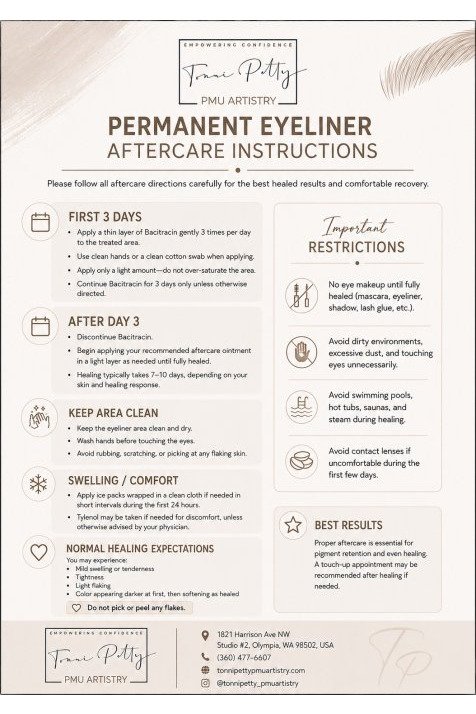
- Do you provide written aftercare instructions?
Correction and Touch-Up Policies:
Understand what happens if you're unhappy:
- What's your policy if I'm unhappy with the result?
- Do you offer free adjustments within a certain timeframe?
- What's the cost of touch-ups? Are they included in the initial price or separate?
- How many touch-ups are typical in the first year?
- Can you lighten, darken, or reshape brows if needed?
- What's your policy on correcting previous PMU work from another artist?
Skin-Specific Questions:
Your skin type affects technique and pigment choice:
- Have you worked with clients who have oily skin? Dry skin? Sensitive skin?
- How do you adjust your technique for different skin types?
- Do you perform a patch test before the full procedure?
- Have you worked with clients taking medications that affect healing (blood thinners, retinoids)?
Contraindication Screening:
A professional artist screens for health conditions that affect safety:
- Do you ask about medications, allergies, or health conditions before the procedure?
- Do you require clients to avoid blood thinners or certain supplements before appointment?
- Do you screen for pregnancy, nursing, or recent Botox/fillers?
- Do you have a written informed consent form?
Evaluating Their Responses:
Pay attention not just to what they answer, but how:
- Do they explain concepts clearly without jargon, or do they assume you understand technical terms?
- Do they ask you questions in return about your skin, lifestyle, and goals?
- Do they seem genuinely interested in whether you're a good fit, or are they just trying to book you?
- Are they defensive when you ask detailed questions, or do they welcome scrutiny?
Step 6: Evaluate Hygiene Standards and Safety Protocols
Hygiene is non-negotiable. Improper sterilization spreads bloodborne pathogens. Cross-contamination causes infection. A sterile environment protects your health and ensures optimal pigment retention.
Sterilization and Equipment Standards:
- Autoclave sterilization: Does the artist use an autoclave (high-pressure steam sterilizer) for reusable tools? Ask when it was last tested. Autoclaves require regular validation to ensure they reach proper temperature and pressure. Legitimate studios maintain autoclave logs.
- Single-use supplies: Are needles, applicators, and pigment containers opened fresh for each client? Watch the artist open new supplies in front of you. If they reuse pigment containers or needles, walk out.
- Hand hygiene: Does the artist wash hands before putting on fresh gloves for your procedure? Do they change gloves between steps (e.g., after touching their face or phone)?
- Sterile field: Is there a designated clean area where tools and pigments are laid out? Are these supplies covered until use?
- Sharps disposal: Are used needles placed immediately in a sharps container, not left on the work surface?
- Workspace cleanliness: Is the treatment room visibly clean? Are surfaces wiped down between clients? Is there clutter or visible dust?
Infection Control Documentation:
Legitimate studios maintain records:
- Do you have a written infection control protocol?
- Can you show me your autoclave maintenance and testing logs?
- Do you require clients to sign an informed consent form that outlines risks?
- Do you screen for contraindications (bloodborne pathogens, active infections, immunosuppression)?
- Do you require a patch test 24-48 hours before the full procedure?
Skin Type Compatibility: A Critical Differentiator
Why skin type matters:
How to assess skin type compatibility:
During your consultation, ask:
- What's your experience with my skin type? Can you show me healed results from clients with similar skin?
- How do you adjust your technique for oily/dry/sensitive skin?
- What pigment do you recommend for my skin type, and why?
- What aftercare do you recommend specifically for my skin type?
- Have you had clients with my skin type who were unhappy? What did you learn from that?
Health Department Compliance:
Licensing and permits vary by state, but all legitimate studios should have:
- A current health department permit for their location
- Compliance with state and local infection control regulations
- Documentation of staff training in bloodborne pathogen prevention
- A written policy on what to do if a client develops an infection
Red Flags for Hygiene and Safety:
- Artist doesn't wear gloves or changes gloves infrequently
- Pigments are in multi-use containers or not sealed
- No autoclave on-site or artist can't explain sterilization process
- Studio is visibly dirty or disorganized
- Artist dismisses hygiene questions or seems annoyed by scrutiny
- No informed consent form or infection control protocol
- Artist claims they've never had a client infection (statistically unlikely if they've done hundreds of procedures)
- No patch test offered or required
These are dealbreakers. Hygiene and safety are non-negotiable.
Step 7: Read Reviews, Testimonials, and Check Legal Recourse
Read reviews on Google, Yelp, and the artist's website. Look for patterns: Are clients consistently happy? Do they mention specific results?
Frequently Asked Questions
What credentials should a reputable PMU artist have?
A reputable PMU artist should hold certification from recognized organizations such as the American Institute of Intradermal Cosmetics or the American Academy of Micropigmentation. They must complete formal training in bloodborne pathogens safety, sterile technique, and pigment theory. Many states require licensure; verify your state's specific requirements with your health department. Ask to see certificates directly, legitimate professionals display them openly and can explain their training background.
How can I verify a PMU artist's health department compliance?
Contact your local or state health department directly and ask if the artist or studio holds a current health permit. Request to see the permit displayed in the studio, it's a legal requirement in most states. Ask about bloodborne pathogens certification and inquire whether the artist has passed health inspections. A reputable PMU artist will provide this information without hesitation and can explain their sterilization protocols and disposal procedures for sharps and biohazard materials.
What are the red flags when choosing a permanent makeup artist?
Red flags include artists who cannot produce certifications, refuse to show before-and-after photos, work from unclean or unlicensed spaces, use non-sterile or reusable tools, and pressure you to skip consultation. Avoid artists who guarantee results, offer suspiciously low pricing, or have no online reviews or testimonials. Be cautious of portfolio photos that look heavily edited or unrealistic. If an artist avoids answering questions about hygiene, licensing, or aftercare, find someone else.
How many sessions does permanent makeup typically require?
Most PMU procedures require an initial session followed by a touch-up session 4-8 weeks later to refine the healed results and ensure color retention. Some techniques like microblading may need additional touch-ups after 12-18 months as pigment fades. During your consultation, a reputable PMU artist will explain the healing timeline, touch-up schedule, and long-term retention expectations specific to your skin type and the technique chosen. Discuss timing and costs for all sessions upfront.